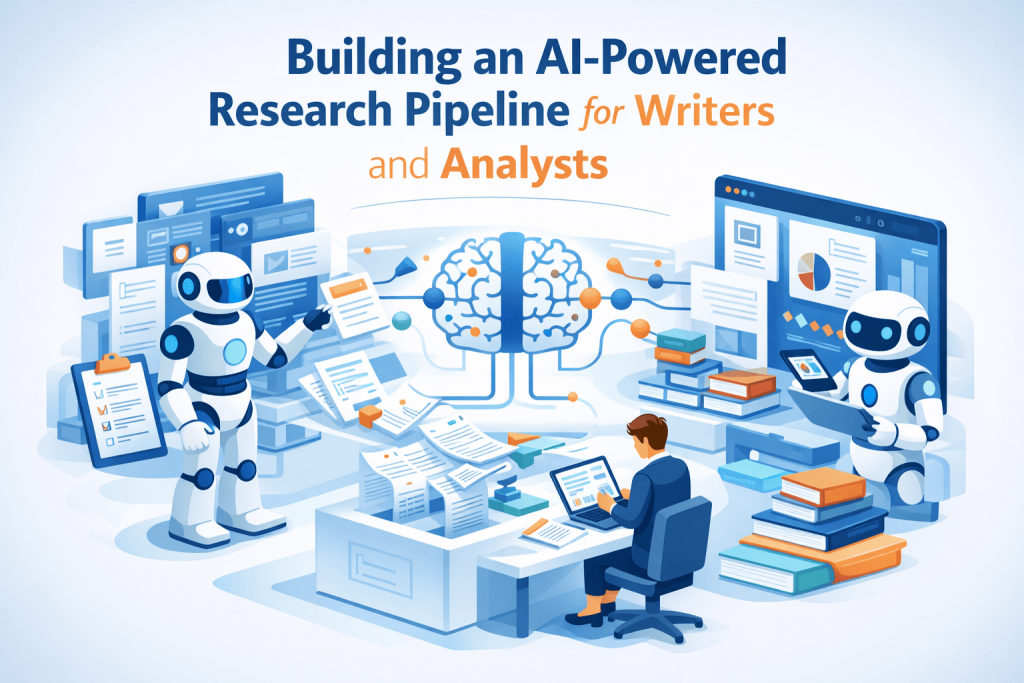

AI tools are transforming how research is conducted by writers, analysts, and knowledge professionals. Traditionally, research involved manual searching, reading large volumes of material, organizing notes, and synthesizing information into structured insights. This process is time-consuming and often fragmented across multiple applications.
An AI-powered research pipeline changes this dynamic. Instead of managing dozens of disconnected research tasks, professionals can structure a system where AI tools assist with information discovery, extraction, organization, and synthesis.
When designed correctly, such pipelines significantly increase research speed while maintaining analytical quality.
Why Research Workflows Need Structural Improvement
Research is rarely a single action. It is a multi-stage process that typically includes:
- discovering relevant information
- evaluating sources
- extracting key insights
- organizing knowledge
- synthesizing conclusions
Writers and analysts often move between browsers, documents, spreadsheets, and note-taking systems. This fragmentation creates cognitive overhead.
An AI-powered research pipeline reduces this complexity by structuring how information flows through each stage of analysis.
According to research from McKinsey & Company, the greatest productivity gains from artificial intelligence occur in tasks involving information processing and communication—exactly the core of research workflows.
Core Stages of an AI-Powered Research Pipeline
A well-designed research pipeline divides research work into several structured stages.
1. Information Discovery
The first stage involves identifying relevant materials.
AI tools can assist by:
- scanning multiple databases simultaneously
- summarizing search results
- identifying related concepts and sources
Instead of manually evaluating hundreds of links, researchers can quickly narrow the information landscape.
2. Source Evaluation
Not all sources are equally reliable. AI can assist researchers by:
- extracting key claims from articles
- highlighting supporting evidence
- identifying conflicting viewpoints
Human judgment remains essential, but AI reduces the effort required to understand large volumes of material.
3. Insight Extraction
Once sources are identified, the next step is extracting useful insights.
AI tools can:
- summarize long documents
- identify key arguments
- extract structured data from reports
This transforms raw information into usable knowledge.
4. Knowledge Organization
Many research projects fail not because of weak analysis but because information becomes disorganized.
AI tools can automatically organize insights into:
- thematic clusters
- structured notes
- linked knowledge graphs
We previously explored similar structural improvements in workflow automation architecture, where information systems are designed to support complex knowledge work.
5. Synthesis and Draft Development
The final stage of research is transforming insights into structured output.
For writers and analysts, this may involve:
- building article outlines
- preparing analytical reports
- drafting arguments based on evidence
AI tools can assist in structuring these outputs while researchers retain control over interpretation and conclusions.
Designing an Effective Research Pipeline
An AI-powered research pipeline works best when it is intentionally designed rather than assembled ad hoc.
Effective systems typically include:
- Clear information sources
Databases, academic resources, or trusted publications. - Structured extraction tools
AI systems that summarize and organize information. - Knowledge management platforms
Systems that store and link research insights. - Human review checkpoints
Ensuring that interpretations remain accurate.
We discussed the importance of these checkpoints in our guide to reliable AI workflows with human oversight.
Human validation ensures that AI-generated insights remain trustworthy.
Risks of Unstructured AI Research
While AI tools significantly accelerate research, poorly structured pipelines can introduce new problems.
Common risks include:
- over-reliance on summarized information
- missing contextual nuance
- inaccurate interpretation of sources
- duplication of research effort
AI should support analytical thinking rather than replace it.
Researchers must remain responsible for validating sources and interpreting conclusions.
The Long-Term Impact on Knowledge Work
As AI capabilities improve, research pipelines will continue evolving.
Future research systems may include:
- automated literature monitoring
- real-time insight detection across data sources
- predictive trend analysis
- continuously updated knowledge graphs
These systems will not eliminate human researchers. Instead, they will augment human cognition by handling repetitive information processing tasks.
For writers and analysts, this shift represents a major opportunity.
Professionals who design structured research pipelines will be able to process information faster, identify deeper insights, and produce higher-quality analysis.
Conclusion
Research has traditionally been a manual, fragmented process. AI tools allow writers and analysts to transform research into a structured pipeline where information discovery, evaluation, extraction, and synthesis occur in coordinated stages.
When combined with human oversight and thoughtful workflow design, an AI-powered research pipeline dramatically improves both research efficiency and analytical depth.
As knowledge work becomes increasingly complex, the professionals who build intelligent research systems will gain a significant advantage in producing accurate, high-value insights.