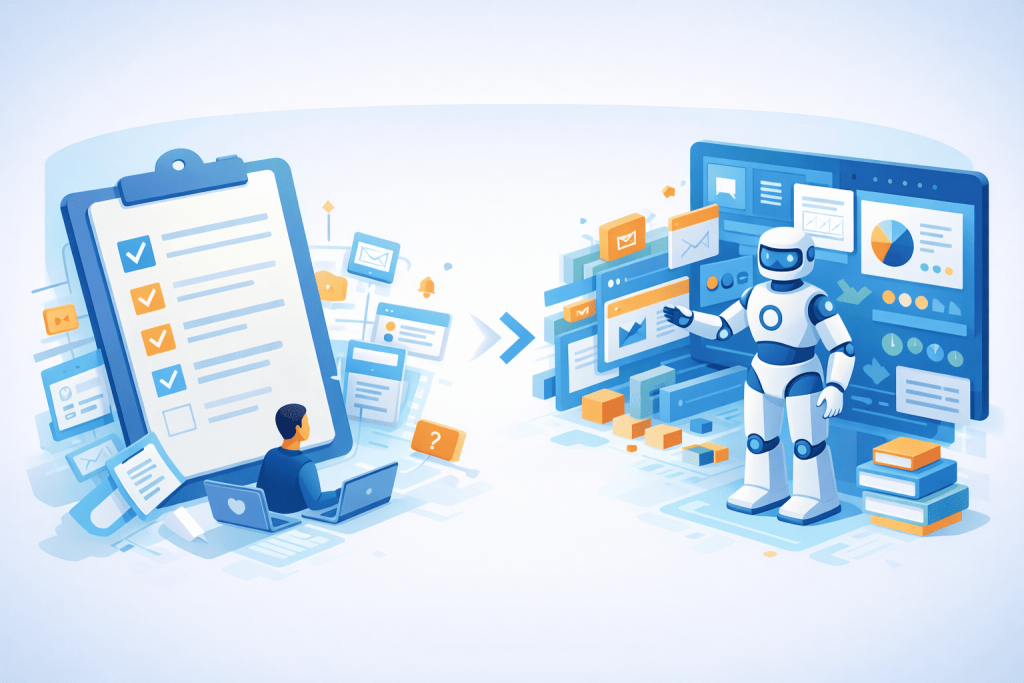

Task orchestration is rapidly replacing traditional productivity models built around to-do lists. For decades, knowledge work has relied on manually tracking tasks, prioritizing work, and executing actions across multiple tools. While effective at a small scale, this approach struggles under the complexity of modern workflows.
As work becomes more distributed, data-heavy, and interconnected, to-do lists are no longer sufficient. A new model is emerging—one where AI systems coordinate tasks, manage dependencies, and execute workflows across tools.
This shift represents a fundamental change in how work is organized.
Why To-Do Lists No Longer Scale
To-do lists are built on a simple assumption: humans manage execution.
They require users to:
- define tasks
- prioritize manually
- track progress
- switch between tools
At low complexity, this works. But as workflows expand, several limitations appear:
- tasks become fragmented across systems
- dependencies are difficult to track
- priorities shift dynamically
- execution requires constant context switching
To-do lists capture tasks, but they do not manage workflows.
The Emergence of Task Orchestration
Task orchestration introduces a different model.
Instead of managing individual tasks, users define outcomes. AI systems then:
- break work into actionable steps
- assign tasks across tools
- monitor progress
- adjust workflows dynamically
This approach reduces the need for manual coordination.
We explored similar structural changes in agent-based orchestration of software, where systems coordinate work across multiple applications instead of relying on user-driven execution.
From Tasks to Workflows
The key difference between to-do lists and task orchestration is structure.
To-Do Lists:
- static
- manually updated
- isolated
- task-focused
Task Orchestration:
- dynamic
- system-managed
- interconnected
- workflow-focused
In a traditional system, tasks are endpoints.
In an orchestrated system, tasks are nodes within a larger workflow.
How AI Enables Task Orchestration
AI systems enable task orchestration by combining several capabilities:
1. Context Awareness
AI systems track:
- ongoing projects
- deadlines
- dependencies
- historical patterns
This allows them to understand how tasks relate to each other.
2. Automation Across Tools
Instead of requiring manual execution, AI systems can:
- update project management tools
- send communications
- generate reports
- trigger follow-up actions
This reduces friction between systems.
3. Dynamic Prioritization
To-do lists require manual prioritization. AI systems adjust priorities based on:
- deadlines
- workload
- changing conditions
This ensures that the most important work is always addressed.
4. Continuous Monitoring
AI systems monitor workflows in real time:
- tracking progress
- identifying bottlenecks
- triggering interventions
This transforms task management into workflow management.
The Role of Workflow Architecture
Task orchestration depends on structured systems.
Without clear architecture, automation becomes fragmented and unreliable.
We examined how poorly designed systems break at scale in workflow automation systems, where a lack of structure leads to instability.
Effective orchestration requires:
- defined workflows
- clear data flows
- integration between tools
- monitoring systems
Orchestration is not just about automation—it is about system design.
Human-in-the-Loop in Task Orchestration
Despite increasing automation, human oversight remains critical.
AI systems can:
- suggest actions
- automate routine steps
- manage workflows
But humans must:
- validate decisions
- handle ambiguous scenarios
- provide strategic direction
As discussed in designing reliable AI workflows with human oversight, structured review mechanisms ensure that automation remains accurate and aligned with goals.
Challenges in Adopting Task Orchestration
Transitioning from to-do lists to AI task orchestration is not trivial.
Common challenges include:
1. Workflow Redesign
Organizations must rethink how work is structured, not just add AI tools.
2. Integration Complexity
Connecting systems requires careful planning.
3. Trust in Automation
Users must become comfortable delegating execution to AI systems.
4. Data Consistency
AI systems rely on structured and reliable data inputs.
Without these foundations, orchestration systems cannot function effectively.
The Future of Work Execution
The shift from to-do lists to task orchestration reflects a broader trend.
Work is moving from:
- manual coordination
- tool switching
- task tracking
toward:
- system-managed workflows
- automated execution
- outcome-based interaction
In this model, users focus less on managing tasks and more on defining objectives.
Conclusion
To-do lists have served knowledge workers for decades, but they are reaching their limits. As workflows become more complex, manual task management cannot keep pace.
Task orchestration represents the next stage in productivity evolution. By leveraging AI systems to coordinate work, manage dependencies, and execute tasks across tools, organizations can reduce cognitive load and improve efficiency.
The future of productivity is not about managing more tasks. It is about designing systems that manage work itself.