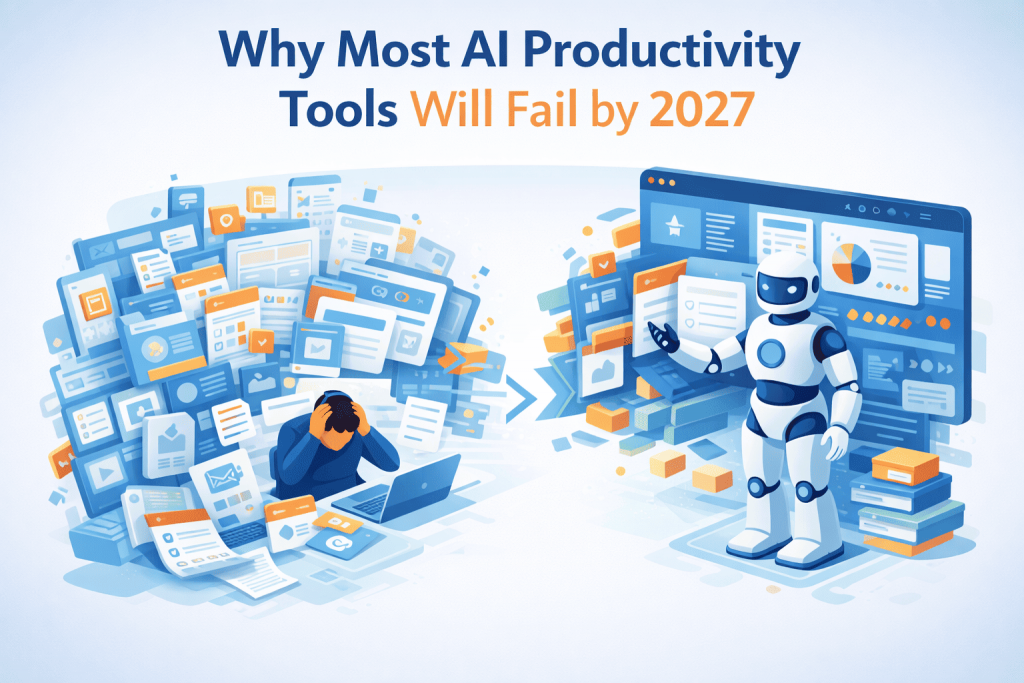

AI productivity tools are expanding at an unprecedented pace. New platforms promise faster writing, smarter task management, better scheduling, and automated workflows. Yet beneath this rapid growth lies a structural problem: most of these tools are built for isolated tasks, not integrated systems.
By 2027, many of today’s AI productivity tools will either disappear, consolidate, or become irrelevant. This is not due to a lack of innovation, but because of a fundamental shift in how work is being organized.
The future of productivity is not about more tools. It is about fewer, more intelligent systems.
The Current Explosion of AI Productivity Tools
The market for AI productivity tools has grown rapidly because they solve immediate problems:
- drafting emails
- summarizing content
- generating ideas
- organizing tasks
These capabilities provide quick wins for individuals. However, they often operate as standalone solutions.
Users adopt multiple tools, each solving a narrow problem, which leads to:
- fragmented workflows
- duplicated effort
- context switching
- increased cognitive load
This fragmentation is the first signal that the current model is unsustainable.
The Structural Problem: Tool-Centric Design
Most AI productivity tools are designed around features rather than workflows.
They assume:
- the user will manage multiple tools
- data will move manually between systems
- context switching is acceptable
This model reflects traditional SaaS architecture, where each tool operates independently.
We explored this limitation in our analysis of agent-based orchestration of software, where workflows begin to replace individual applications.
As complexity increases, tool-centric design becomes inefficient.
Why Scaling Breaks AI Productivity Tools
At a small scale, AI productivity tools feel powerful. On a larger scale, their limitations become clear.
1. Context Fragmentation
Each tool holds part of the workflow:
- one for writing
- one for notes
- one for tasks
- one for analysis
This fragmentation prevents a unified understanding of work.
2. Redundant Functionality
Many tools begin to overlap in capabilities:
- multiple summarization features
- similar automation triggers
- duplicated integrations
Users end up paying for and managing redundant systems.
3. Integration Complexity
As teams scale, connecting tools becomes increasingly difficult.
Workflows require:
- API integrations
- data synchronization
- permission management
This complexity reduces the efficiency gains promised by automation.
The Shift Toward AI Systems and Agents
The next phase of productivity is not about adding more AI tools. It is about replacing them with coordinated systems.
AI agents change the model:
- users define outcomes
- systems orchestrate tasks
- tools become invisible infrastructure
Instead of switching between applications, users interact with a single system that manages workflows end-to-end.
This shift represents a move from tool usage to system interaction.
The Role of Workflow Architecture
AI productivity tools fail when they are not embedded in structured workflows.
Without architecture, tools create:
- disconnected outputs
- inconsistent data flows
- unreliable automation
We examined how this problem scales in workflow automation systems, where poorly designed automation becomes fragile over time.
Future productivity systems will be defined not by features, but by how well they integrate into cohesive workflows.
The Governance Problem
Another critical weakness of current AI productivity tools is the lack of oversight.
Many tools produce outputs that are:
- fluent but inaccurate
- incomplete
- misaligned with business context
Without structured review systems, these tools introduce risk rather than reduce it.
As discussed in the context of designing reliable AI workflows with human oversight, human-in-the-loop systems are essential for maintaining quality and accountability.
Tools that ignore governance will struggle to scale in professional environments.
Economic Pressure and Market Consolidation
The current landscape of AI productivity tools is highly fragmented.
Over time, market forces will lead to consolidation:
- larger platforms will absorb smaller tools
- multi-functional systems will replace niche solutions
- users will prefer integrated environments over fragmented stacks
This pattern has already occurred in previous software cycles.
The difference now is that AI accelerates both innovation and consolidation.
What Will Survive
Not all AI productivity tools will fail. The ones that survive will share common characteristics:
1. System Integration
They operate as part of larger workflows rather than standalone tools.
2. Context Awareness
They maintain a unified understanding of user data and tasks.
3. Workflow Orchestration
They automatically coordinate actions across multiple systems.
4. Human Oversight
They include mechanisms for review and validation.
The Future of Productivity
By 2027, productivity will be defined less by tools and more by systems.
Users will interact with:
- AI agents
- unified workflow environments
- context-aware systems
The number of visible tools will decrease, while underlying complexity increases.
For knowledge workers, this shift will reduce cognitive load and increase output quality.
Conclusion
The rapid growth of AI productivity tools reflects real demand for efficiency. However, most of these tools are built on a model that does not scale.
Fragmentation, redundancy, and lack of integration will limit their long-term relevance.
The future belongs to systems that unify workflows, maintain context, and incorporate human oversight.
By 2027, the landscape will look very different. Many tools will disappear, but the underlying capabilities they introduced will persist—integrated into more cohesive, intelligent systems.