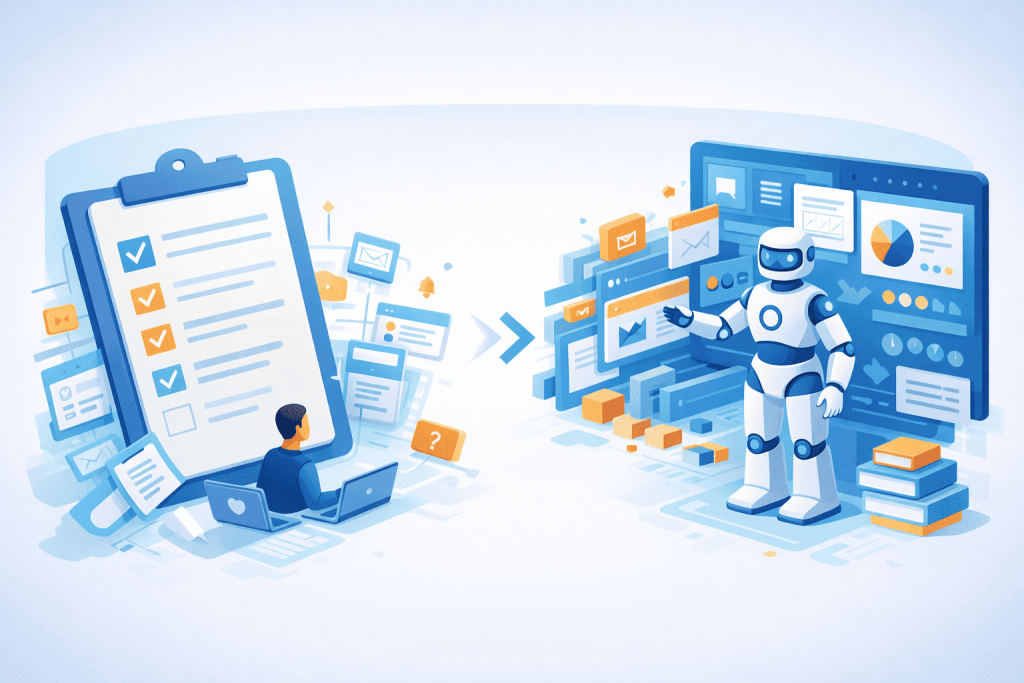

Event-driven automation is redefining how modern systems respond to change. Instead of relying on scheduled processes or manual triggers, organizations are increasingly building workflows that react instantly to events—data updates, user actions, or system signals.
When combined with AI, this model becomes significantly more powerful. Event-driven AI automation enables systems not only to react to changes but also to interpret them, decide what matters, and execute appropriate actions across workflows.
This shift moves automation from passive execution to active system behavior.
What Is Event-Driven Automation
Event-driven automation is a system design approach where actions are triggered by events.
An event can be:
- a new record in a database
- a change in a data field
- a user interaction
- an external API signal
Instead of running workflows at fixed intervals, systems respond immediately when these events occur.
This reduces latency and allows workflows to operate in near real-time.
Why Event-Driven Models Matter
Traditional automation relies on:
- scheduled jobs
- batch processing
- manual triggers
These approaches introduce delays and limit responsiveness.
Event-driven automation improves:
- reaction speed
- system efficiency
- resource usage
- workflow relevance
By acting only when something changes, systems avoid unnecessary processing.
According to research from McKinsey & Company, real-time data utilization is becoming a key driver of productivity and decision-making in modern organizations.
How AI Enhances Event-Driven Automation
AI transforms event-driven systems from reactive pipelines into intelligent workflows.
1. Event Interpretation
Not all events are equally important.
AI systems can:
- filter noise
- classify events
- detect anomalies
- prioritize actions
This prevents workflows from being triggered unnecessarily.
2. Context-Aware Decision Making
When an event occurs, AI can evaluate:
- historical data
- user behavior
- system context
This allows the system to choose the most appropriate response.
3. Dynamic Action Selection
Instead of predefined rules, AI can:
- select actions based on context
- adapt workflows over time
- optimize execution paths
This introduces flexibility into automation systems.
4. Continuous Learning
AI systems improve by learning from past events and outcomes.
Over time, workflows become more accurate and efficient.
From Triggers to Intelligent Workflows
The key evolution in event-driven automation is the transition from simple triggers to intelligent orchestration.
Traditional model:
- Event → Trigger → Action
AI-driven model:
- Event → Interpretation → Decision → Action → Feedback
This layered approach allows systems to handle complexity more effectively.
We explored similar architectural evolution in agent-based orchestration of software, where systems coordinate actions across tools rather than executing isolated tasks.
Designing Event-Driven AI Systems
Building effective event-driven AI automation requires a structured design.
Define Meaningful Events
Not every data change should trigger action.
Focus on events that:
- impact outcomes
- require response
- signal important changes
Establish Clear Workflows
Define how the system should respond:
- what actions are possible
- which conditions apply
- how decisions are made
Integrate Across Systems
Event-driven workflows often span:
- databases
- CRMs
- communication tools
- analytics platforms
Integration ensures that actions can be executed seamlessly.
Include Human Oversight
AI-driven systems should include checkpoints where necessary.
We discussed the importance of governance in designing reliable AI workflows with human oversight, where human validation ensures accuracy and accountability.
Common Challenges
Despite its advantages, event-driven AI automation introduces new complexities.
1. Event Overload
Too many triggers can overwhelm systems.
2. Data Quality Issues
Inaccurate data leads to incorrect actions.
3. Integration Complexity
Connecting multiple systems increases architectural complexity.
4. Lack of Observability
Without monitoring, it is difficult to track system behavior.
These challenges highlight the need for careful system design.
The Future of Event-Driven AI Automation
As organizations adopt real-time systems, event-driven AI automation will become foundational.
Future developments may include:
- autonomous decision-making systems
- predictive event detection
- self-optimizing workflows
- real-time operational intelligence
This evolution will move organizations closer to fully adaptive systems.
Conclusion
Event-driven automation shifts workflows from scheduled execution to real-time responsiveness. When combined with AI, it enables systems to interpret data changes, make decisions, and execute actions dynamically.
For organizations managing complex workflows, this approach offers greater efficiency, responsiveness, and scalability.
The future of automation is not just about executing tasks. It is about building systems that understand when and how to act.

Pingback: Choosing AI Tools That Scale with Your Workflow
Pingback: How to Connect AI Tools to Your CRM Without Custom Code