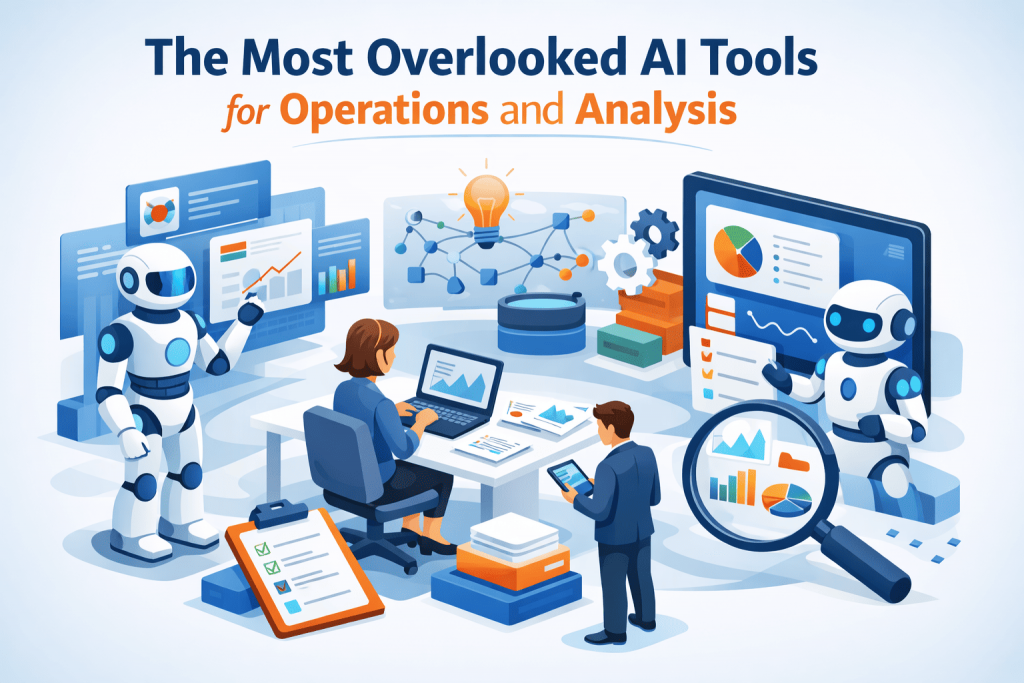

AI tools are often associated with writing assistants, chat interfaces, and generative content platforms. Yet some of the most powerful applications of artificial intelligence appear not in visible productivity features but in operations and analytical workflows.
Operations teams and analysts spend much of their time organizing information, reconciling datasets, preparing reports, and identifying patterns across systems. Many AI systems designed for these tasks remain overlooked because they operate quietly in the background, improving decision-making rather than producing visible outputs.
Understanding these tools can significantly improve how organizations manage operational complexity and analytical workloads.
Why AI Tools for Operations and Analysis Matter
Operational and analytical work is rarely limited by intelligence. It is limited by time and information structure.
Professionals working in operations often face:
- fragmented data sources
- inconsistent reporting formats
- manual spreadsheet consolidation
- repetitive analytical preparation
AI tools reduce these friction points by automating information processing and structuring insights.
According to research from McKinsey & Company, the most significant productivity gains from artificial intelligence come from activities involving data interpretation and communication.
For operations teams, this makes AI tools particularly valuable.
Categories of Overlooked AI Tools
While generative assistants receive the most attention, several other categories of AI systems provide high leverage in operational environments.
1. AI Data Structuring Systems
Operations teams frequently receive data in unstructured formats:
- emails
- PDFs
- spreadsheets
- reports
AI tools can automatically extract structured fields, normalize formats, and integrate information into databases or analytics platforms.
This eliminates a significant amount of manual preparation work.
2. Automated Insight Detection
Many AI tools analyze operational datasets and surface patterns that humans might miss.
These systems can:
- identify anomalies in operational metrics
- detect emerging trends in customer behavior
- highlight performance deviations across departments
Rather than replacing analysts, these tools expand analytical coverage.
3. Document Intelligence Platforms
Operations frequently involve large volumes of documentation, such as:
- contracts
- invoices
- operational reports
- compliance records
AI-powered document intelligence tools classify documents, extract key fields, and flag inconsistencies.
This reduces the time required for document review and compliance monitoring.
4. AI-Powered Operational Summarization
Executives and operations managers often receive long reports and dashboards that require synthesis.
AI tools can transform:
- complex datasets
- meeting transcripts
- operational updates
into concise summaries and decision briefs.
This improves decision velocity without sacrificing analytical depth.
The Strategic Advantage of Analytical AI Tools
AI tools used in operations and analysis rarely receive the same attention as content-generation systems. However, their impact is often more significant.
These tools improve:
- decision accuracy
- operational visibility
- reporting efficiency
- analytical scalability
By automating low-level data processing, organizations allow analysts to focus on interpretation rather than preparation.
We explored similar system-level efficiency gains in our analysis of workflow automation architecture.
Common Reasons These AI Tools Are Overlooked
Several factors explain why operational AI tools remain underutilized.
1. Visibility Bias
Generative tools produce visible outputs such as text or images. Operational AI systems work behind the scenes.
2. Implementation Complexity
Operational environments often require integration across multiple systems, which slows adoption.
3. Misalignment with Traditional Workflows
Organizations frequently adopt AI tools without redesigning workflows, limiting their effectiveness.
4. Lack of Data Governance
AI tools rely on consistent data structures. Poor data hygiene can limit their usefulness.
Integrating AI Tools into Operational Workflows
To unlock their full value, AI systems should not be deployed as standalone features.
Instead, they should be integrated into structured workflows.
Effective implementation typically involves:
- defining data sources
- standardizing reporting formats
- introducing review checkpoints
- monitoring outputs
We previously examined how reliable AI workflows with human oversight ensure that automation remains accurate and accountable.
Human validation remains essential when operational decisions depend on AI-generated insights.
Risks of Misusing AI in Operations
While AI tools offer strong advantages, improper deployment can introduce risks.
Common problems include:
- over-reliance on automated insights
- misinterpreting algorithmic signals
- ignoring data quality issues
- automating flawed workflows
AI should enhance analytical processes rather than replace domain expertise.
Operations professionals must maintain interpretive authority over results.
The Future of Operational AI Systems
As AI technology matures, operational and analytical systems will become increasingly integrated.
Future tools will likely include:
- real-time anomaly detection
- autonomous operational monitoring
- predictive workflow optimization
- intelligent reporting pipelines
These capabilities will transform operations from reactive management into proactive system optimization.
Organizations that adopt analytical AI tools early will gain deeper visibility into their processes and faster decision cycles.
Conclusion
Many discussions about artificial intelligence focus on visible productivity gains. Yet some of the most valuable AI tools operate quietly within operational and analytical workflows.
By structuring data, detecting insights, and summarizing complex information, these tools allow organizations to move faster without sacrificing analytical rigor.
The most overlooked AI tools may ultimately become the most strategically important.
Operations and analysis form the backbone of modern organizations. AI tools designed for these domains will increasingly define how effectively companies interpret information and act on it.