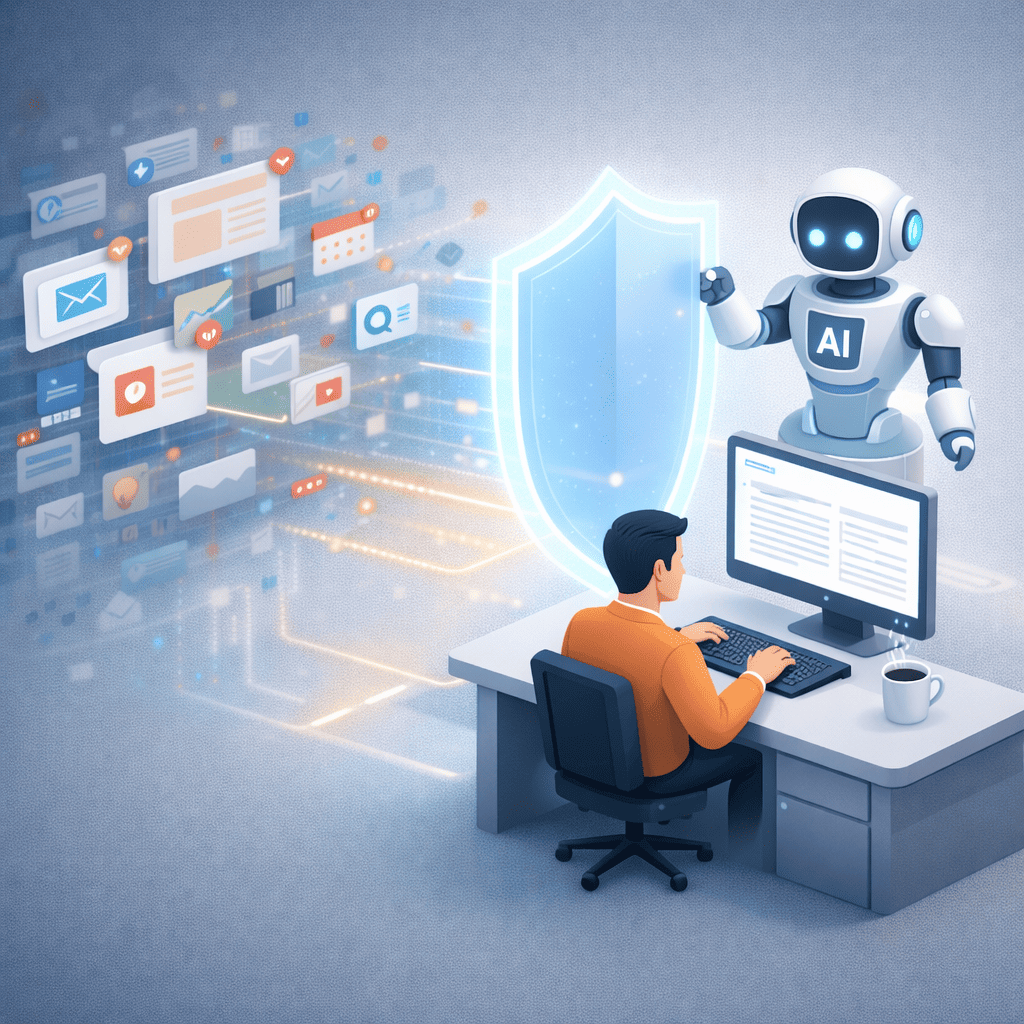

AI productivity systems are increasingly positioned as accelerators of output. Yet their most strategic function may be defensive rather than generative. In an environment defined by notifications, fragmented workflows, and constant digital interruption, the real opportunity is protecting deep work.
Deep work — sustained, cognitively demanding focus — has become scarce. AI productivity systems, when designed correctly, can act as cognitive filters rather than cognitive amplifiers.
Why Deep Work Is Under Threat
Modern knowledge work is structured around:
- Messaging platforms
- Email threads
- SaaS dashboards
- Real-time collaboration tools
- Continuous updates
The result is attention fragmentation.
Research from McKinsey & Company suggests that productivity gains from AI will depend on how systems are integrated into workflows. Without integration discipline, automation can increase noise rather than reduce it.
Deep work requires:
- Time blocking
- Reduced context switching
- Minimal cognitive residue
- Clear task definition
AI productivity systems can either protect these conditions—or undermine them.
How AI Productivity Systems Protect Deep Work
When designed strategically, AI productivity systems perform three protective functions.
1. Noise Filtering
AI can:
- Summarize long email threads
- Condense meeting transcripts
- Prioritize urgent messages
- Defer non-critical notifications
Instead of consuming raw information streams, professionals interact with structured digests.
This reduces cognitive switching cost.
2. Task Clarification
Deep work fails when tasks are ambiguous.
AI productivity systems can:
- Transform vague objectives into structured outlines
- Break large initiatives into sequenced actions
- Identify missing inputs
- Surface dependencies
Clarity accelerates entry into focused states.
3. Workflow Consolidation
One of the biggest threats to deep work is tool hopping.
AI systems reduce:
User → Tool A → Tool B → Tool C
into:
User → AI layer → Coordinated systems
This orchestration reduces interface fatigue and preserves mental bandwidth.
We previously examined how agent-based orchestration restructures software architecture. The same principle applies at the individual productivity level.
The Difference Between Acceleration and Protection
Most discussions about AI emphasize speed. Speed is not the same as depth.
Acceleration without filtering can increase:
- Output volume
- Task switching
- Shallow processing
Protection, by contrast, focuses on:
- Cognitive boundary management
- Information compression
- Interrupt minimization
- Attention preservation
AI productivity systems that prioritize depth will outperform systems that merely increase throughput.
Designing AI Around Deep Work Principles
To protect deep work, AI systems must be configured intentionally.
Define Interruption Rules
Set parameters for:
- Notification batching
- Escalation thresholds
- Auto-scheduling windows
AI should not mirror real-time noise; it should regulate it.
Separate Generation from Consumption
Use AI for:
- Draft generation
- Research synthesis
- Idea expansion
But consume results during scheduled review blocks, not continuously.
Implement Human-in-the-Loop Oversight
Autonomous filtering can misclassify priority.
Human-in-the-loop systems ensure:
- Critical signals are not suppressed
- Strategic context is preserved
- Escalation logic remains aligned
Deep work protection requires governance, not blind automation.
Risks of Misaligned AI Use
If implemented incorrectly, AI productivity systems can:
- Multiply notifications
- Increase output expectations
- Create dependency on drafts
- Encourage reactive workflows
The paradox is simple:
AI meant to save time can consume attention.
The structural difference lies in configuration.
Organizational Implications
For teams, protecting deep work requires policy alignment.
Organizations should:
- Define no-meeting windows
- Establish asynchronous communication norms
- Clarify response time expectations
- Limit tool proliferation
AI productivity systems amplify whichever structure already exists.
If chaos governs the organization, AI scales chaos.
If discipline governs workflows, AI scales clarity.
Measuring Deep Work Protection
To evaluate whether AI is protecting deep work, track:
- Time spent in uninterrupted blocks
- Reduction in notification volume
- Fewer tool transitions per task
- Output quality metrics
- Decrease in reactive communication
If interruptions remain constant, the system is not configured correctly.
The Strategic Role of AI in Focus Preservation
The long-term competitive advantage of AI may not lie in writing faster emails or generating more documents.
It may lie in:
- Preserving attention
- Compressing information
- Eliminating redundant cognitive effort
- Protecting high-value thinking
Deep work produces disproportionate results in knowledge industries. Systems that safeguard it create a durable advantage.
Conclusion
AI productivity systems should not be evaluated solely on output speed. Their deeper value lies in protecting attention.
In a fragmented digital environment, the scarcest resource is not information. It is a focus.
Organizations and individuals that configure AI to defend deep work — rather than disrupt it — will produce higher-quality decisions, clearer strategy, and sustained intellectual advantage.
AI will either fragment attention further or restore cognitive boundaries. The outcome depends on system design.