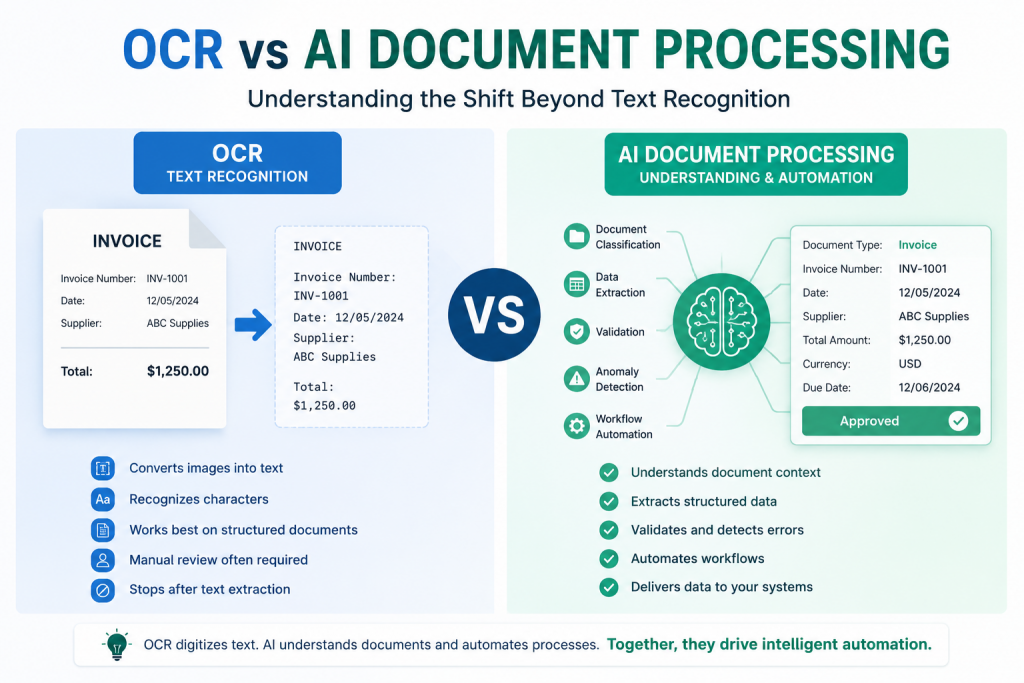

OCR vs AI document processing is one of the most common comparisons for organisations investing in document automation. While OCR converts images into text, AI document processing understands documents, extracts structured data, and automates business workflows. Businesses process millions of documents every day, from invoices and contracts to purchase orders, receipts, and customer forms. For decades, Optical Character Recognition (OCR) has been the primary technology used to convert paper documents into digital text. While OCR remains an essential component of document digitisation, it is no longer sufficient for organisations seeking end-to-end automation.
Artificial intelligence has fundamentally changed document processing by moving beyond simple text recognition. Modern AI document processing systems can classify documents, extract key information, understand context, validate data, and even trigger automated business workflows without human intervention.
Understanding the difference between OCR and AI document processing is essential for organisations planning digital transformation initiatives.
What Is OCR?
Optical Character Recognition (OCR) is a technology that converts printed or handwritten characters into machine-readable text. After scanning a document or analysing an image, OCR identifies letters and numbers and outputs editable digital content.
Typical OCR applications include:
- Digitising paper archives
- Converting scanned PDFs into searchable documents
- Reading printed invoices
- Extracting text from forms
- Processing receipts
OCR dramatically reduced manual typing and made document storage far more efficient. However, its primary purpose is recognising characters—not understanding information.
For example, an OCR engine may correctly identify the following invoice fields:
- Invoice Number
- Supplier Name
- Invoice Date
- Total Amount
Yet it does not inherently understand which value belongs to which field or whether the extracted information is complete or accurate.
The Limitations of Traditional OCR
Although OCR is highly effective at recognising text, it struggles when documents become more complex.
Common challenges include:
- Different invoice layouts
- Poor scan quality
- Rotated pages
- Handwritten notes
- Multiple languages
- Tables with inconsistent formatting
- Missing or partially visible fields
More importantly, OCR cannot determine what a document actually represents.
A purchase order, an insurance claim, and an employment contract may all contain similar words, but OCR treats them simply as blocks of recognised text.
As a result, organisations often need employees to manually review extracted information before it enters business systems.
What Is AI Document Processing?
AI document processing builds on OCR by combining machine learning, natural language processing (NLP), computer vision, and automation technologies.
Instead of only recognising characters, AI systems interpret documents much like a human reviewer would.
Modern AI document processing platforms can:
- Detect document type automatically
- Classify incoming files
- Extract structured data
- Understand document context
- Validate information
- Identify anomalies
- Route documents to the correct workflow
- Integrate directly with ERP and CRM systems
Rather than producing raw text, these systems generate structured, actionable information.
How AI Extends OCR
OCR should not be viewed as obsolete. Instead, it has become one component within a larger intelligent workflow.
A modern document processing pipeline typically follows these steps:
- OCR extracts text from the document.
- AI identifies the document category.
- Key fields are located and extracted.
- Business rules validate the extracted information.
- Confidence scores determine whether human review is necessary.
- Approved data is automatically transferred into downstream systems.
This approach reduces manual intervention while improving both speed and accuracy.
OCR vs AI Document Processing
| OCR | AI Document Processing |
|---|---|
| Recognises text | Understands document context |
| Converts images into text | Extracts structured business data |
| Requires predefined templates in many cases | Adapts to multiple layouts using AI |
| Limited validation | Validates information automatically |
| Manual review often required | Human review only for exceptions |
| Stops after text extraction | Continues into workflow automation |
The key distinction is that OCR digitises information, whereas AI document processing enables organisations to act on that information automatically.
Real-World Example
Imagine an accounts payable department receiving 2,000 supplier invoices every week.
Using traditional OCR:
- Each invoice is scanned.
- Text is extracted.
- Employees verify supplier names.
- Invoice numbers are checked manually.
- Totals are confirmed.
- Data is entered into the accounting system.
Using AI document processing:
- Invoices are classified automatically.
- Supplier information is recognised regardless of layout.
- Invoice totals are validated against purchase orders.
- Duplicate invoices are detected.
- Exceptions are flagged.
- Approved invoices are sent directly into the finance system.
Instead of accelerating data entry, AI automates the entire process.
Business Benefits of AI Document Processing
Organisations adopting AI-powered document processing typically aim to improve operational efficiency rather than simply reduce paperwork.
Common benefits include:
Higher accuracy
Machine learning models continuously improve their ability to recognise document patterns, reducing extraction errors over time.
Faster processing
Documents that previously required several minutes of manual review can often be processed within seconds.
Lower operational costs
Automating repetitive document handling allows employees to focus on higher-value activities.
Improved compliance
Automated validation creates consistent processing rules and detailed audit trails.
Better scalability
As document volumes grow, AI systems can handle increasing workloads without requiring proportional increases in staffing.
When OCR Alone Is Enough
Not every organisation requires advanced AI.
Traditional OCR remains appropriate when:
- Documents follow a fixed template.
- Only searchable text is needed.
- Manual verification is acceptable.
- Processing volumes are relatively low.
Examples include scanning historical archives or converting printed books into digital documents.
When AI Document Processing Delivers More Value
AI becomes increasingly valuable when organisations handle:
- Multiple document formats
- High document volumes
- Complex approval workflows
- Frequent exceptions
- Compliance-sensitive processes
- Cross-department automation
Industries such as finance, healthcare, insurance, logistics, and legal services often benefit significantly because document processing directly affects operational performance.
The Future of Document Automation
The evolution from OCR to AI document processing reflects a broader shift in enterprise automation.
Businesses no longer seek technologies that merely digitise information. They increasingly require systems capable of understanding documents, making routine decisions, and integrating seamlessly with automated workflows.
As AI models continue to improve, document processing will become less about recognising text and more about enabling intelligent business operations.
OCR remains an important foundation, but AI transforms documents from static files into actionable business assets that support faster decisions, more efficient workflows, and scalable automation.