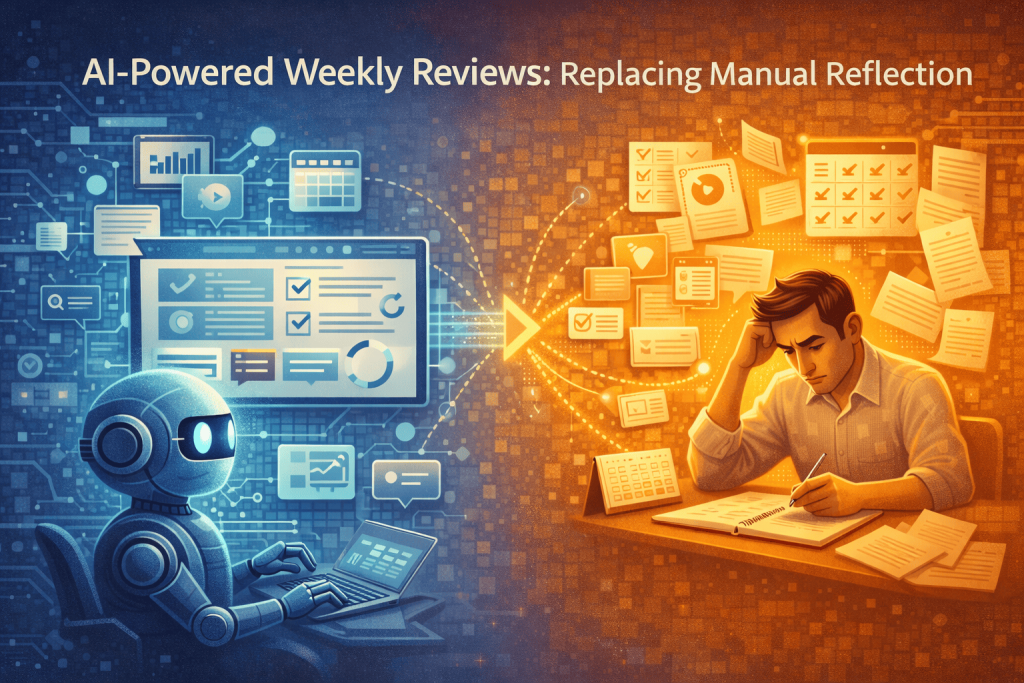

Weekly reviews are designed to create clarity, reset priorities, and align work with long-term goals. In practice, however, weekly reviews often become inconsistent, rushed, or skipped entirely. AI-powered weekly reviews redefine this process by transforming reflection from a manual ritual into a structured, adaptive system.
The goal is not to remove reflection. It is to remove friction.
Why Weekly Reviews Often Fail
Review frameworks are conceptually simple:
- review tasks completed
- assess unfinished work
- identify priorities
- plan the upcoming week
Yet many professionals struggle to maintain the habit. Common reasons include:
- lack of time
- incomplete data across tools
- unclear review structure
- cognitive fatigue at the end of the week
Manual reflection requires mental reconstruction. You must recall what happened, gather scattered information, and interpret it under pressure.
Over time, this friction erodes consistency.
What AI-Powered Weekly Reviews Actually Change
AI-powered review systems do not eliminate the need for judgment. Instead, they reduce the cognitive cost of preparing for reflection.
An AI-powered system can:
- aggregate tasks across tools
- summarize completed work
- detect recurring patterns
- highlight unfinished commitments
- surface priority conflicts
Instead of starting with a blank page, you start with structured insight.
This reduces decision fatigue and increases follow-through.
From Manual Reconstruction to Context-Aware Summaries
Traditional review frameworks rely on memory and scattered documentation.
AI-powered weekly reviews shift the process toward context-aware summaries.
For example, AI can:
- compare planned vs completed tasks
- identify time allocation imbalances
- detect repeated postponements
- highlight neglected strategic projects
This transforms this process from subjective reflection into data-informed evaluation.
Importantly, the human remains responsible for interpretation.
Designing an AI-Powered Weekly Review System
To make an AI-powered process effective, structure matters.
1. Centralize Inputs
Ensure the system pulls from:
- task managers
- calendars
- documents
- project boards
- communication tools
Without centralized inputs, summaries remain incomplete.
2. Define Clear Review Sections
AI should organize the review system into predictable sections, such as:
- Completed Work
- Delayed Tasks
- Strategic Progress
- Operational Load
- Emerging Risks
- Next Week Priorities
Consistency improves decision clarity.
3. Highlight Decisions, Not Just Data
Data alone does not improve productivity.
AI-powered the weekly cycle should prompt:
- What should be deprioritized?
- What requires escalation?
- Which commitments need renegotiation?
- Where is attention misaligned?
This mirrors the broader shift from static reporting to decision-driven systems described in Why Productivity Systems Fail (and How AI Fixes That).
Avoiding Over-Automation in Reflection
There is a risk in fully automating reflection.
If AI produces conclusions rather than insights, users disengage.
AI-powered system should:
- summarize objectively
- surface signals
- preserve context
- avoid prescribing a strategy without input
Automation supports clarity. It should not replace thinking.
How AI-Powered Weekly Reviews Improve Consistency
Consistency is the hidden value of this process.
Manual systems fail because they depend on:
- motivation
- discipline
- uninterrupted time
AI-powered weekly reviews reduce activation energy.
When summaries are generated automatically:
- starting the review takes less effort
- insights are easier to interpret
- patterns become visible over time
This transforms weekly reviews from an optional habit into a reliable system.
When AI-Powered Weekly Reviews Work Best
AI-powered weekly reviews are especially effective when:
- work spans multiple tools
- responsibilities are diverse
- strategic and operational work compete
- interruptions are frequent
In these contexts, automation preserves visibility without increasing workload.
This approach aligns with the principles behind end-to-end AI workflows, where context continuity matters more than isolated automations.
Measuring Impact Over Time
The effectiveness of AI-powered weekly reviews becomes visible across weeks, not days.
Improvements typically include:
- fewer forgotten commitments
- better alignment with long-term goals
- reduced backlog growth
- improved prioritization discipline
Over time, patterns become measurable.
The review process evolves from reactive correction to proactive alignment.
The Role of Human Oversight
AI-powered weekly reviews enhance clarity, but humans remain accountable.
A lightweight review loop ensures:
- priorities reflect real-world constraints
- strategic goals remain visible
- anomalies are interpreted correctly
Reflection is augmented, not outsourced.
Final Thoughts
Weekly reviews are powerful when they are consistent and structured.
AI-powered weekly reviews reduce the friction that prevents reflection from happening. By aggregating data, preserving context, and highlighting decisions, AI transforms weekly reviews into operational infrastructure.
The objective is not faster reflection.
It is better alignment.
When weekly reviews become adaptive systems rather than manual rituals, productivity becomes sustainable.