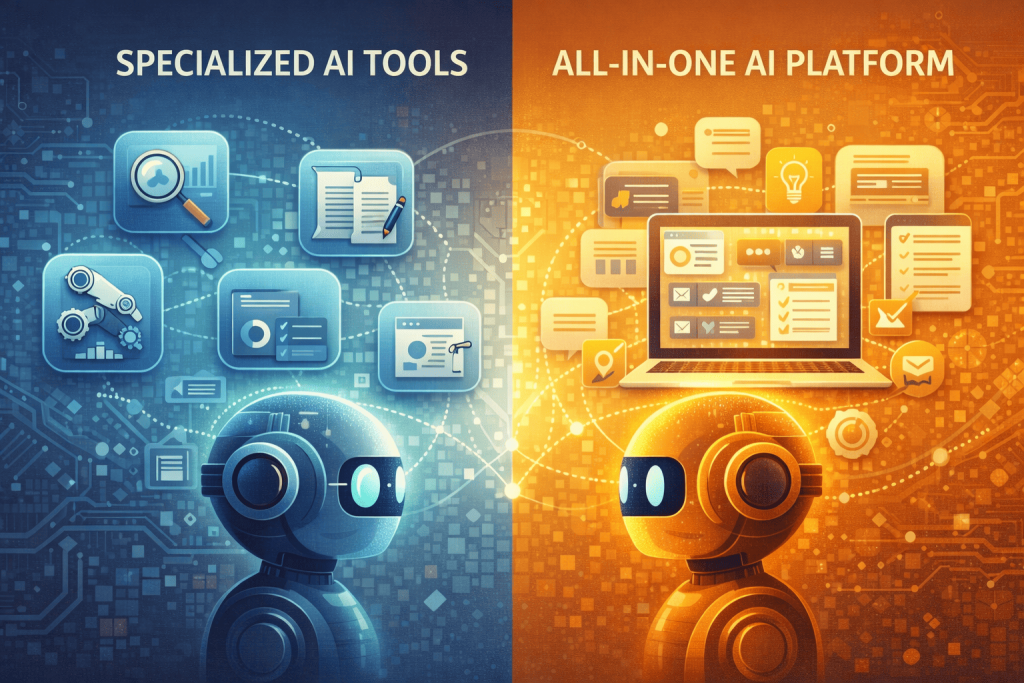

AI tools are evolving in two very different directions. On one side, we see highly specialized solutions built to solve one specific problem extremely well. On the other hand, all-in-one platforms promise to centralize multiple workflows inside a single ecosystem.
Both models claim efficiency. Both promise integration. But in practice, they produce very different outcomes.
The real question is not which model is more powerful. It is which one works better for your specific type of work?
What Are Specialized AI Tools?
Specialized AI tools are designed for narrow, clearly defined use cases.
Examples include:
- AI-powered data analysis platforms
- document processing systems
- research summarization engines
- workflow orchestration tools
- AI-driven reporting assistants
Their strength lies in depth. They optimize one workflow layer instead of trying to replace an entire stack.
For instance, many specialized AI tools for data analysis outperform general platforms when advanced modeling or domain-specific interpretation is required.
What Are All-in-One AI Platforms?
All-in-one platforms aim to reduce tool fragmentation.
They typically offer:
- content generation
- automation builders
- analytics dashboards
- collaboration features
- integrations under one interface
The value proposition is simplicity. Instead of stitching tools together, teams operate within a unified environment.
For smaller teams or early-stage operations, this can significantly reduce overhead.
Depth vs Convenience
The trade-off between specialized AI tools and all-in-one platforms can be summarized as:
Depth vs Convenience
Specialized tools:
- deliver stronger performance in focused tasks
- adapt better to complex workflows
- integrate into larger systems
All-in-one platforms:
- reduce setup complexity
- minimize integration friction
- simplify onboarding
The decision depends on workflow maturity.
When Specialized AI Tools Work Better
Specialized AI tools perform best when:
- workflows are complex
- performance accuracy matters
- outputs require customization
- automation must scale over time
In advanced knowledge environments, systems often evolve beyond the limits of bundled platforms. This is where modular architectures outperform centralized ones.
This shift is closely related to the broader transition from tools to systems described in Why AI Automation Is Shifting from Tools to Systems.
When All-in-One Platforms Make More Sense
All-in-one platforms work well when:
- workflows are relatively simple
- speed of implementation is critical
- teams lack technical integration resources
- standardization matters more than optimization
They reduce decision fatigue around tool selection and maintenance.
However, as workflows grow more nuanced, the constraints of a single platform often become visible.
The Integration Question
The real difference is not feature count. It is architectural flexibility.
Specialized AI tools are designed to plug into larger ecosystems. They assume integration is necessary.
All-in-one platforms attempt to eliminate integration by internalizing functionality.
In dynamic environments, integration usually wins over consolidation.
Performance, Lock-In, and Risk
Specialized AI tools reduce platform dependency but increase coordination complexity.
All-in-one platforms reduce coordination but increase lock-in risk.
Long-term sustainability depends on:
- data portability
- API access
- interoperability
- system transparency
Evaluating AI tools through these criteria is essential.
Decision Framework: What Works Better?
Instead of asking which is better universally, ask:
- How complex are your workflows?
- How critical is performance precision?
- How often do requirements change?
- Do you expect to scale or remain stable?
For static environments, consolidation works.
For evolving systems, specialization scales better.
The Hybrid Model
Increasingly, organizations adopt a hybrid strategy:
- Core infrastructure in a stable platform
- Critical workflows handled by specialized AI tools
- AI agents coordinating across both layers
This approach balances flexibility with operational simplicity.
Final Thoughts
AI tools are no longer competing in a single category. They represent different philosophies of system design.
All-in-one platforms optimize for convenience and centralization.
Specialized AI tools optimize for depth and adaptability.
What works better depends on whether your priority is short-term simplicity or long-term system resilience.
In most mature environments, specialization eventually outperforms consolidation — not because it is trendier, but because complexity requires precision.