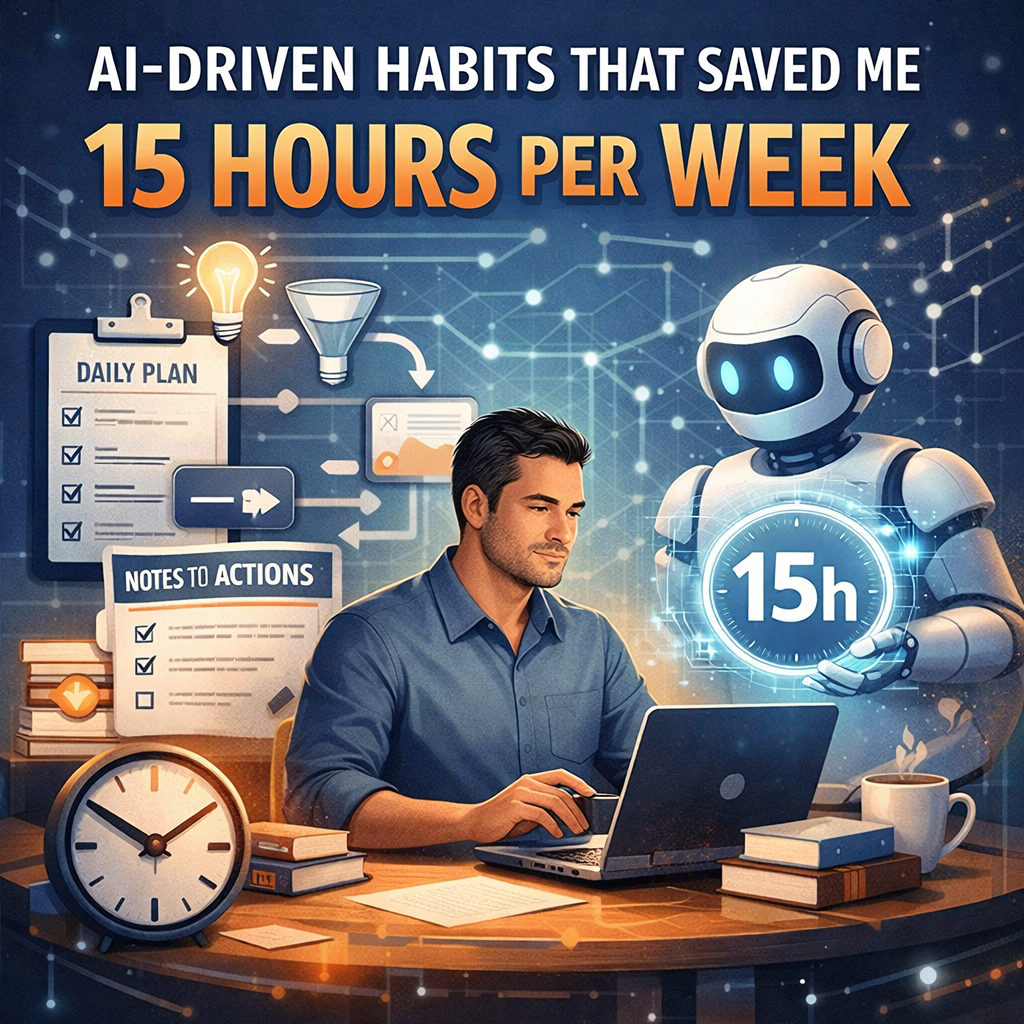

AI-driven habits changed how I think about productivity. Not by helping me do more, but by removing friction from recurring decisions.
Over the past few years, I stopped treating AI as a collection of tools and started using it as a behavioral layer over my daily work. The result was not a dramatic overnight change, but something more valuable: consistent time savings. Today, those small gains add up to roughly 15 hours per week.
Below are the AI-driven habits that made the biggest difference, and why they work.
AI-Driven Habits That Changed My Productivity System
These AI-driven habits were not designed to maximize output. They were designed to reduce mental load, decision fatigue, and unnecessary repetition. Over time, this approach reshaped my entire productivity system.
1. Replacing Decisions With Defaults
Most time loss comes from decisions that should not exist in the first place.
Instead of deciding how to start work every morning, I use AI to define defaults:
- A fixed daily planning prompt
- A pre-generated task breakdown
- A short priority check based on deadlines and energy level
AI does not tell me what to do. It removes the need to decide repeatedly. That alone saves 20–30 minutes per day.
The habit is simple: I never start work without running the same planning prompt. No creativity, no variation, no optimization loops.
2. Turning Notes Into Action Automatically
Raw notes are useless unless they become actions.
Every meeting, article, or idea goes into a single capture system. AI processes those notes into:
- Clear action items
- Follow-ups
- “Parking lot” ideas for later review
This habit removed hours of weekly re-reading and manual sorting. More importantly, it reduced cognitive load. I no longer wonder whether something was forgotten.
The key is consistency. AI works best when the input format stays stable.
3. Writing First, Editing Later (With AI)
Perfectionism is one of the biggest productivity killers.
I separate writing into two distinct phases:
- Fast, unfiltered drafting
- AI-assisted restructuring and editing
AI helps clean structure, remove repetition, and improve clarity. I do not ask it to “make it better.” I ask it to optimize for readability and logic.
This habit alone cut my writing time almost in half, without lowering quality.
4. Delegating Micro-Tasks to Automation
Small tasks are dangerous because they fragment attention.
I use lightweight AI automations for:
- Formatting documents
- Summarizing long threads
- Preparing reusable responses
- Converting ideas into outlines
Each task saves only a few minutes. Combined, they reclaim hours per week. More importantly, they protect deep work time.
This is where AI-driven productivity becomes less about speed and more about attention management.
5. Weekly AI Reviews Instead of Daily Overthinking
Daily optimization creates noise. Weekly reflection creates clarity.
Once a week, I run a short AI-assisted review:
- What consumed the most time?
- What created value?
- What should be eliminated or automated next?
This habit prevents productivity from becoming performative. The goal is not to look busy, but to remove unnecessary work.
AI acts as a neutral observer, not a motivator.
Why AI-Driven Habits Scale Over Time
One important advantage of AI-driven habits is that they scale with complexity. As projects grow, traditional productivity systems often break down because they rely on manual effort and constant attention.
AI-based habits adapt more naturally. When inputs stay consistent, AI can handle increasing volumes of information without requiring extra cognitive effort. This makes them especially effective for long-term work, content creation, and multi-project environments.
Over time, this creates a compounding effect. Each habit saves a small amount of time, but together they form a system that remains stable even as the workload increases. Instead of constantly rebuilding productivity setups, the system evolves quietly in the background.
Why These Habits Work
These habits succeed because they change behavior, not just tools.
AI works best when:
- Inputs are predictable
- Decisions are minimized
- Reviews happen on a fixed schedule
Used this way, AI becomes an invisible layer that supports focus instead of demanding attention.
The real productivity gain is not the 15 hours. It is the mental space those hours create.