Automating Knowledge Work Without Losing Context
Knowledge work automation promises efficiency, speed, and scale. Yet many automation initiatives quietly fail because they remove something essential in the process: context. When systems automate tasks without preserving why decisions are made, work becomes faster but less reliable.
The real challenge is not automating knowledge work. It is automating it without losing context.
Why Context Is the Core Asset of Knowledge Work
Unlike procedural work, knowledge work depends on:
- intent
- judgment
- historical understanding
- situational awareness
Tasks are rarely independent. A decision made today often depends on what happened yesterday, what changed this morning, and what is expected next week. Context connects actions into meaning.
When automation strips work down to isolated steps, it removes the very signals humans rely on to make good decisions.
How Automation Commonly Breaks Context
Most automation systems are designed around events, not understanding.
They excel at:
- triggering actions
- moving data
- enforcing rules
They struggle with:
- preserving reasoning
- tracking assumptions
- maintaining narrative across steps
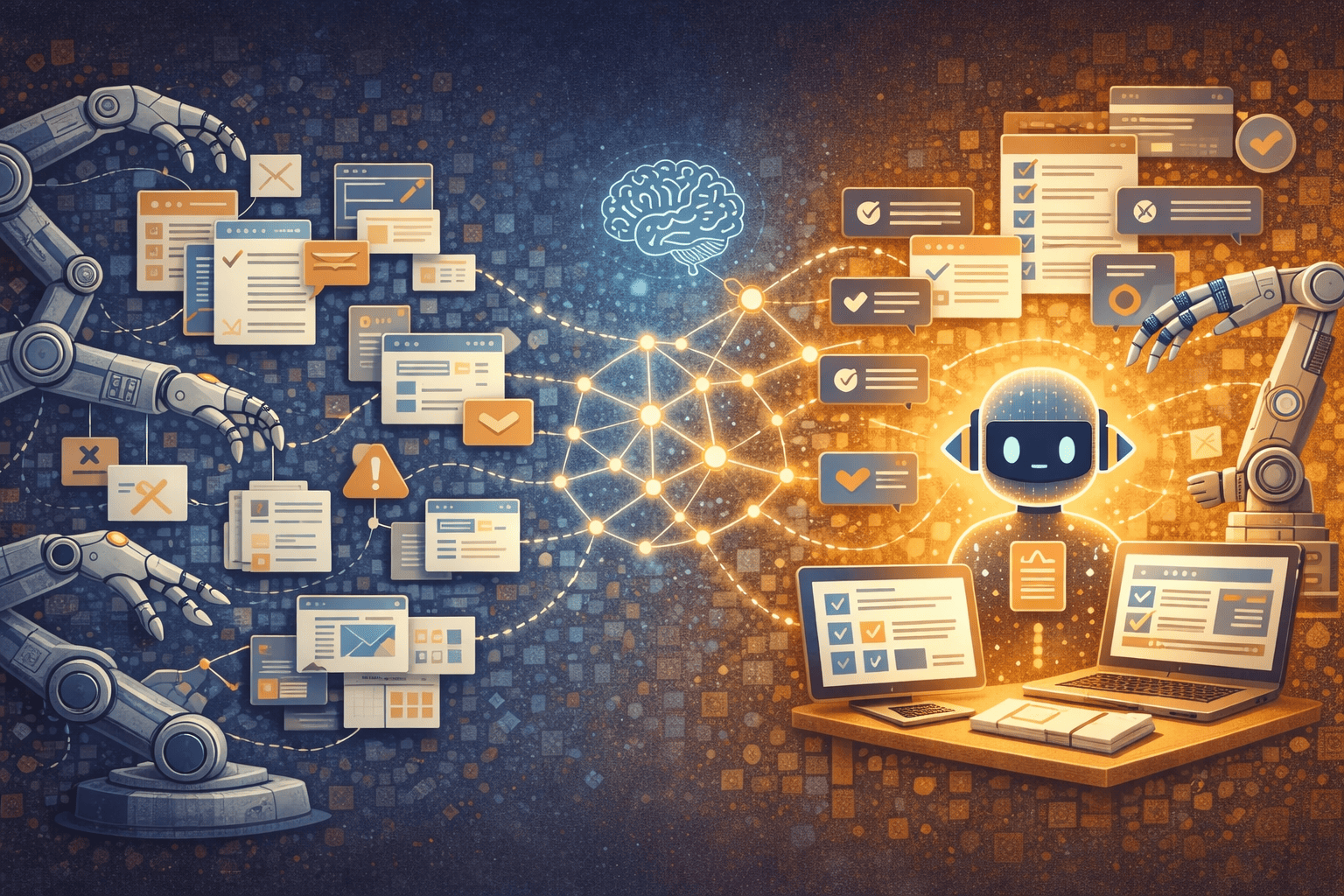
As automation layers grow, context becomes fragmented across tools. Humans are then forced to reconstruct it manually, often under time pressure. This is where efficiency gains quietly disappear.
The Difference Between Task Automation and Knowledge Automation
Task automation answers:
“What should happen when X occurs?”
Knowledge automation asks:
“Why does X matter, and what should follow?”
Without this distinction, automation optimizes execution while degrading decision quality. This is the same structural issue discussed in Why AI Automation Is Shifting from Tools to Systems, where isolated automations fail to scale because they lose connective tissue.
Context Loss Increases Cognitive Load
When context is missing, humans must compensate.
They:
- double-check automated outputs
- search for background information
- hesitate before acting
- override systems more frequently
This increases decision fatigue, even when fewer tasks are performed manually. Automation meant to reduce effort ends up shifting effort to less visible, more mentally taxing work.
(internal link anchor: decision fatigue → “How AI Reduces Decision Fatigue in Knowledge Work”)
How AI Preserves Context When Designed Correctly
AI changes automation when it is used to carry context forward, not just trigger actions.
Well-designed AI systems:
- maintain state across steps
- reference historical decisions
- adapt outputs based on changing conditions
- surface relevant context at the moment of action
Instead of replacing judgment, AI supports it by preserving the surrounding information.
Designing Automation Around Flows, Not Events
Context survives when automation is designed around flows.
Flows:
- span multiple tools
- evolve over time
- include feedback and review
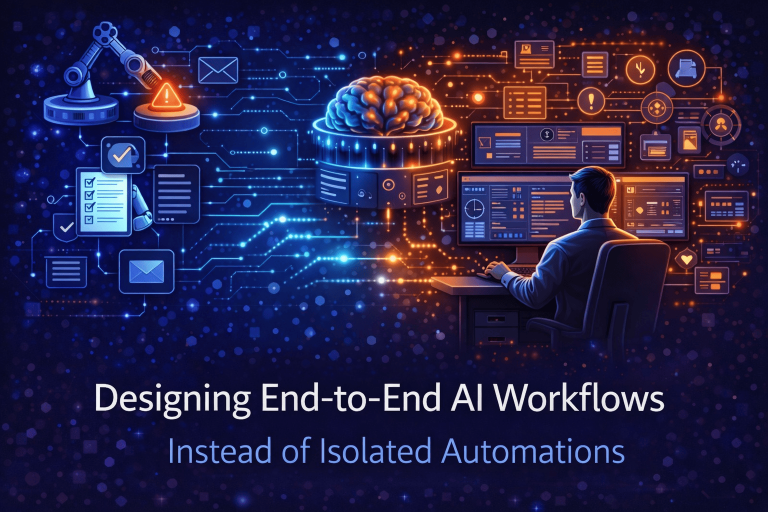
Event-based automation reacts. Flow-based automation understands progression. This is why end-to-end AI workflows outperform isolated automations in complex environments.
Human-in-the-Loop Is a Context Strategy
Keeping humans in the loop is not a safety measure. It is a context strategy.
Humans provide:
- interpretation
- exception handling
- value judgment
Effective systems:
- automate routine transitions
- escalate ambiguity
- make assumptions visible
When humans are removed entirely, context collapses. When they are involved intentionally, automation becomes more reliable.
Common Mistakes in Knowledge Work Automation
Context is usually lost when organizations:
- automate before mapping workflows
- treat documents and data as self-explanatory
- optimize speed over understanding
- rely on dashboards instead of narratives
These mistakes lead to systems that look efficient but require constant supervision.
When Automation Without Context Becomes Risky
Context loss is especially dangerous when:
- decisions have long-term impact
- compliance or ethics are involved
- multiple teams rely on shared outputs
- work is non-reversible
In these cases, automation should slow decisions down slightly rather than accelerate them blindly.
Designing Context-Preserving Automation Systems
Context-preserving systems share common traits:
- clear decision boundaries
- traceable reasoning
- visible uncertainty
- gradual adaptation
This people-first approach aligns with Google’s guidance on building helpful systems, which emphasizes trust, transparency, and long-term usefulness over raw optimization.
Final Thoughts
Automating knowledge work is not about doing more faster. It is about doing the right things with understanding.
AI enables automation that carries context forward instead of stripping it away. When systems preserve intent, history, and meaning, automation becomes an extension of human thinking rather than a replacement for it.
The future of knowledge work automation is not speed.
It is continuity.