AI Tools Workflows Are Changing Everyday Business in 2026
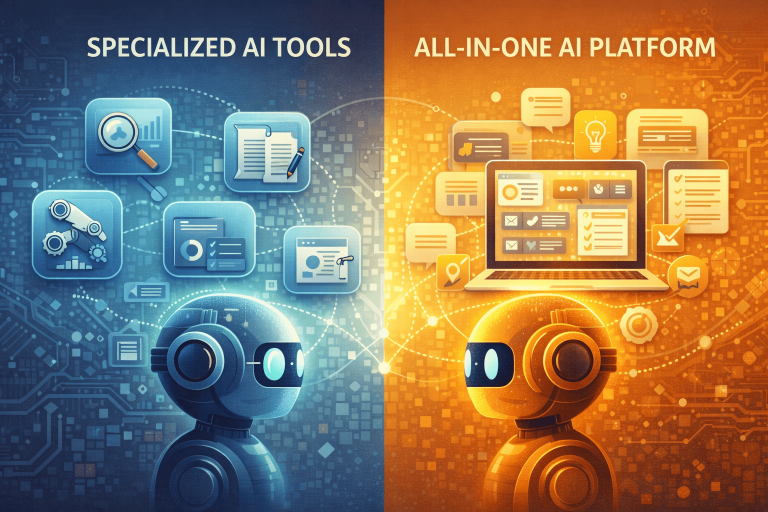
Over the last decade, I’ve tested hundreds of productivity systems, but nothing has reshaped AI tools workflows as deeply as the current generation of intelligent systems. What once required multiple disconnected apps and constant manual coordination can now be handled by a single platform that understands context and intent.
AI tools workflows today are not designed to replace people. They are about reducing friction. Tasks like summarizing documents, organizing information, drafting emails, or analyzing data are now faster, cleaner, and far less error-prone when integrated correctly into your daily routine.
Why AI Tools Workflows Changed Work, Not Jobs
Early automation focused on raw speed. Modern AI focuses on deep understanding. The biggest shift I’ve seen in my 10+ years of experience is that tools no longer require users to adapt to rigid, robotic systems. Instead, the systems adapt to how people actually work.
This is especially visible in knowledge-heavy roles. Writers, analysts, managers, and consultants now rely on AI tools workflows to handle the repetitive cognitive load. This allows human experts to focus on high-level decision-making and creative problem-solving where human judgment is irreplaceable.
Practical Examples of AI Implementation in 2026
To reach maximum productivity, consider these three pillars of modern automation:
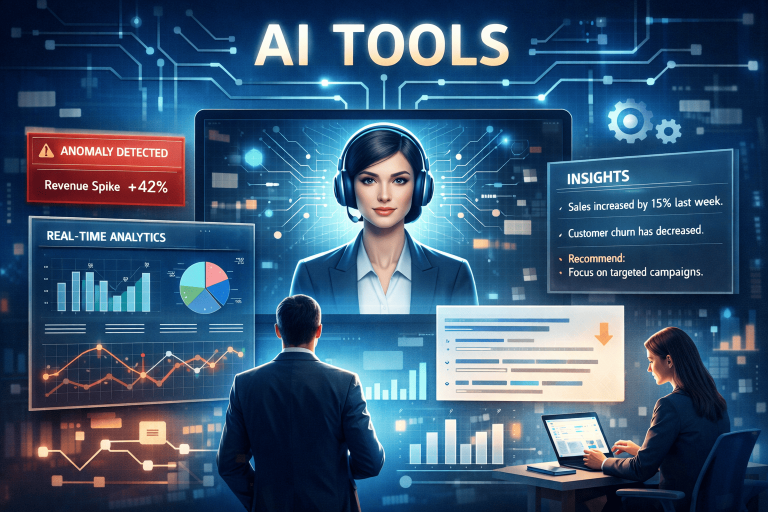
- Smart Data Analysis: Instead of manual spreadsheets, AI now identifies trends and anomalies in seconds, providing actionable insights without human bias.
- Proactive Communication: Automated drafting of emails and reports allows for faster response times while maintaining a personal, human touch in every interaction.
- Self-Updating Documentation: Meeting notes and project updates are no longer static files; they are live documents that update themselves based on team conversations.
The Real Productivity Gains I’ve Seen in Teams
In remote teams, these intelligent layers have quietly become the main coordination hubs. Meeting summaries, task extraction, follow-ups, and documentation happen automatically in the background.
Over time, this changes human behavior. Teams communicate more clearly because the AI handles the “busy work” of organization. According to recent research by McKinsey, AI-driven workflows primarily improve productivity by reducing coordination overhead rather than eliminating roles. Productivity improves not because people work harder or longer hours, but because they waste significantly less mental energy on administrative maintenance.
How I Evaluate AI Tools Before Recommending Them
After testing hundreds of AI-driven systems, I follow a simple evaluation framework.
First, I check whether the tool reduces context switching.
Second, I observe how well it integrates into existing workflows instead of forcing new habits.
Finally, I measure long-term impact: does the team rely on it naturally after 30 days, or does usage fade? Most tools fail at the second step. The few that pass all three usually become permanent parts of daily work.
Common Pitfalls: Where AI Tools Still Fall Short
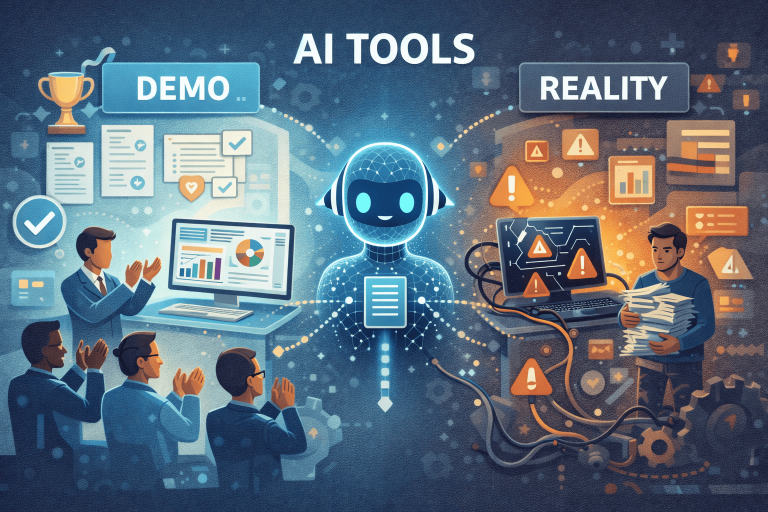
It is important to remember that AI is not magic. Tools still fail when underlying processes are unclear or poorly designed. If a workflow is fundamentally broken, automating it only makes the problem occur faster and at a larger scale.
The most successful teams I’ve worked with treat AI as a highly capable assistant, not a final decision-maker. Human oversight remains the most essential part of the loop to ensure quality and ethical standards.
The Future of Work Is Augmented
As we look ahead, the future of work is not fully automated; it is augmented. AI tools workflows are becoming a quiet but essential layer in everyday business, supporting people rather than replacing them. Those who learn how to integrate these tools thoughtfully today will gain a massive long-term advantage in the evolving digital economy.