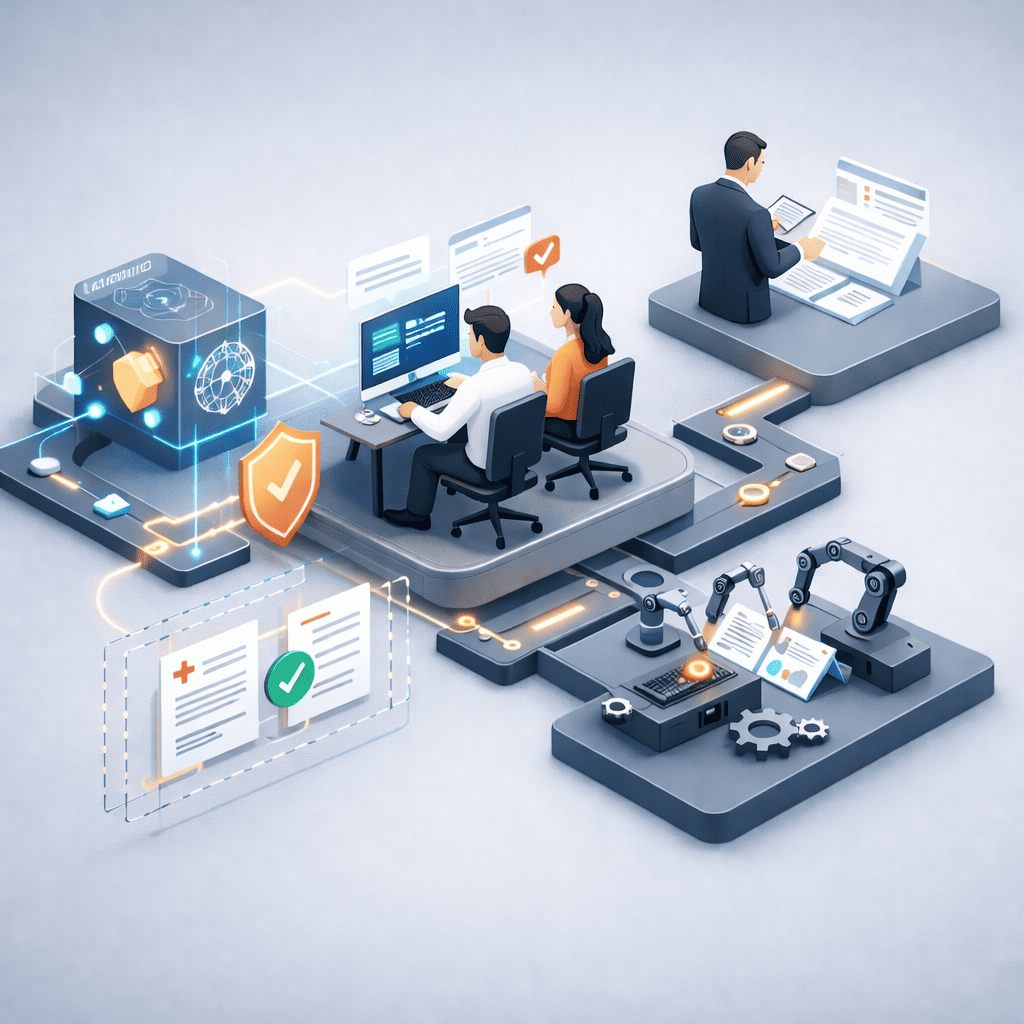
AI Tools for Knowledge Workers, Not Developers
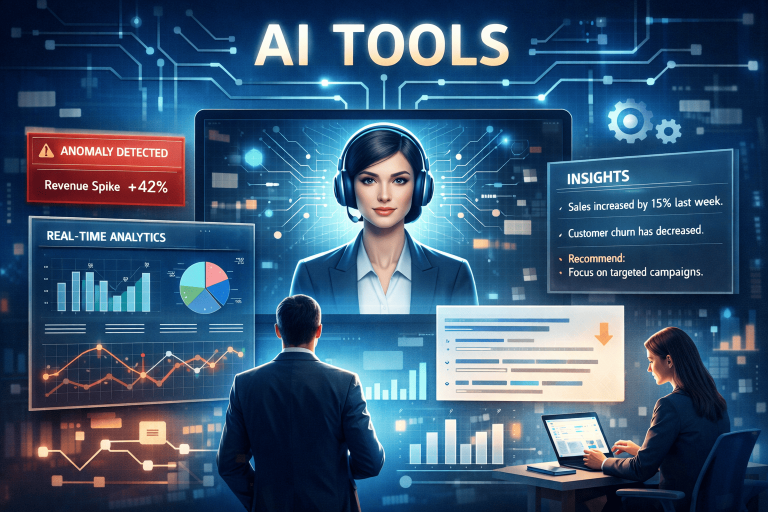
AI tools are often discussed through the lens of developers, engineers, and technical teams. Yet the largest impact of AI is not happening in code editors. It is unfolding across knowledge work — in strategy documents, research synthesis, meeting preparation, decision briefs, and operational planning.
The misconception that AI is primarily a developer tool limits adoption inside organizations. In reality, AI tools for knowledge workers are reshaping how thinking itself is structured, accelerated, and validated.
How AI Tools Transform Knowledge Work
Knowledge work is defined by synthesis, judgment, coordination, and communication. Unlike software development, it operates under ambiguity rather than deterministic logic. That makes structured support more valuable than raw computational power.
AI systems change knowledge workflows in three structural ways:
1. Cognitive Offloading
Tasks such as summarizing long documents, extracting patterns from reports, or drafting structured outlines no longer require full manual effort. The AI handles transformation; the human focuses on interpretation.
2. Structural Thinking Support
Rather than replacing expertise, AI tools help formalize reasoning. They:
- Generate alternative perspectives
- Surface missing assumptions
- Stress-test arguments
- Identify logical inconsistencies
This transforms AI from a writing assistant into a reasoning partner.
3. Speed Without Loss of Depth
Acceleration does not mean superficial output. Properly designed AI workflows allow knowledge workers to iterate faster while maintaining strategic oversight.
According to research from McKinsey & Company, generative AI could significantly increase productivity in activities involving communication and analysis — core components of knowledge work.
The opportunity is not in coding. It is in structured thinking at scale.
AI Tools vs. Developer Tools: A Structural Difference
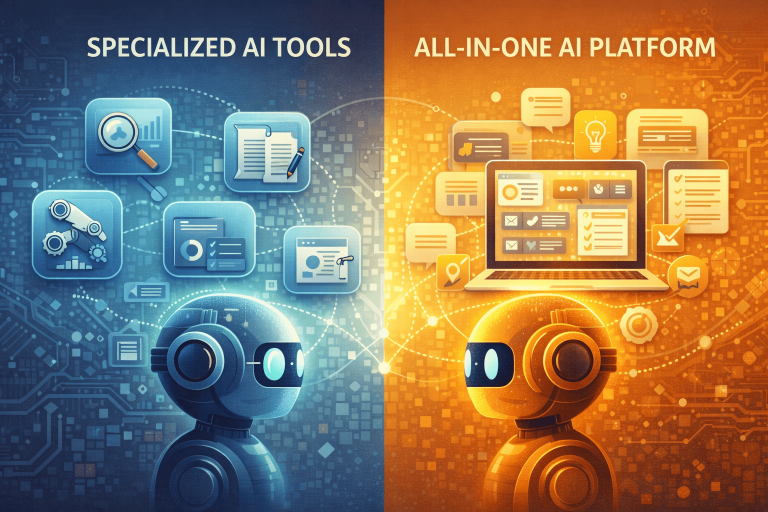
The confusion arises because early AI adoption centered on programming assistance. However, AI tools for knowledge workers differ fundamentally from developer tools.
| Developer Context | Knowledge Worker Context |
|---|---|
| Code correctness | Decision quality |
| Deterministic logic | Ambiguous inputs |
| Syntax validation | Concept validation |
| Automated testing | Human oversight |
For developers, reliability is binary. For knowledge workers, reliability is contextual.
This distinction explains why AI governance and review layers are critical when deploying AI tools outside engineering environments.
If your organization is exploring scalable AI workflows, we discussed governance models in detail in our article on structured automation systems.
What Knowledge Workers Actually Need from AI Tools
Most non-technical professionals do not need:
- API access
- Model fine-tuning
- Code-level configuration
They need:
- Context retention
- Structured outputs
- Multi-step reasoning
- Editable drafts
- Transparency in assumptions
In other words, AI tools must integrate into thinking processes, not technical stacks.
Research & Synthesis
Analysts and strategists use AI to:
- Summarize multi-source inputs
- Extract themes
- Compare arguments
- Generate briefing notes
Communication
Executives and managers use AI tools for:
- Email drafting
- Executive summaries
- Presentation structuring
- Meeting preparation
Decision Support
AI becomes valuable when:
- Comparing scenarios
- Highlighting trade-offs
- Identifying risk exposure
- Stress-testing proposals
The key insight: AI tools augment cognition. They do not replace domain expertise.
The Governance Question
AI tools for knowledge workers introduce a unique risk: over-reliance on fluent output.
Fluency is not accuracy.
Without structured review systems, organizations risk:
- Confident but flawed analyses
- Policy misalignment
- Reputational exposure
- Strategic drift
To mitigate these risks, organizations must design governance into their operational architecture. We explored this structural approach in detail in our guide to designing reliable AI workflows with human oversight.
The Stanford AI Index by Stanford University highlights that AI systems require structured oversight when deployed in real-world environments.
For knowledge work, human-in-the-loop systems are not optional. They are architectural components.
Implementation Model for Non-Technical Teams
To deploy AI tools effectively across knowledge teams, follow a staged approach.
Stage 1 — Draft Acceleration
AI generates first drafts. Humans edit and validate.
Low risk. High adoption.
Stage 2 — Structured Workflows
AI integrates into repeatable processes:
- Research pipelines
- Reporting templates
- Meeting preparation frameworks
Human review remains mandatory at key checkpoints.
Stage 3 — System Integration
AI tools connect with:
- Documentation platforms
- CRM systems
- Project management systems
At this stage, observability becomes critical.
Common Misconceptions
“AI Is Too Technical”
Modern AI tools are interface-driven, not code-driven. The barrier is cognitive adoption, not technical literacy.
“AI Replaces Thinking”
In practice, AI shifts thinking upward — toward evaluation, strategy, and synthesis.
“AI Output Is Final”
For knowledge workers, AI output is a draft artifact, not a decision.
Strategic Implications
Organizations that restrict AI tools to engineering teams create asymmetry:
- Developers gain leverage
- Knowledge teams lag behind
- Strategic throughput remains unchanged
When AI tools are embedded into knowledge workflows:
- Decision cycles shorten
- Documentation quality improves
- Research depth increases
- Cognitive load decreases
The competitive advantage emerges not from model sophistication but from systematic integration.
Conclusion
AI tools are not developer utilities disguised as productivity software. They are a cognitive infrastructure for knowledge workers.
The shift is structural:
From manual drafting to assisted reasoning.
From slow synthesis to iterative refinement.
From fragmented research to structured insight generation.
Organizations that recognize this distinction will design AI systems around thinking, not coding.
In the coming years, the most productive teams will not be those with the most advanced models — but those who embed AI tools directly into the architecture of knowledge work.