How to Evaluate AI Tools Without Falling for Demos
AI tools rarely fail during demos. They fail after adoption.
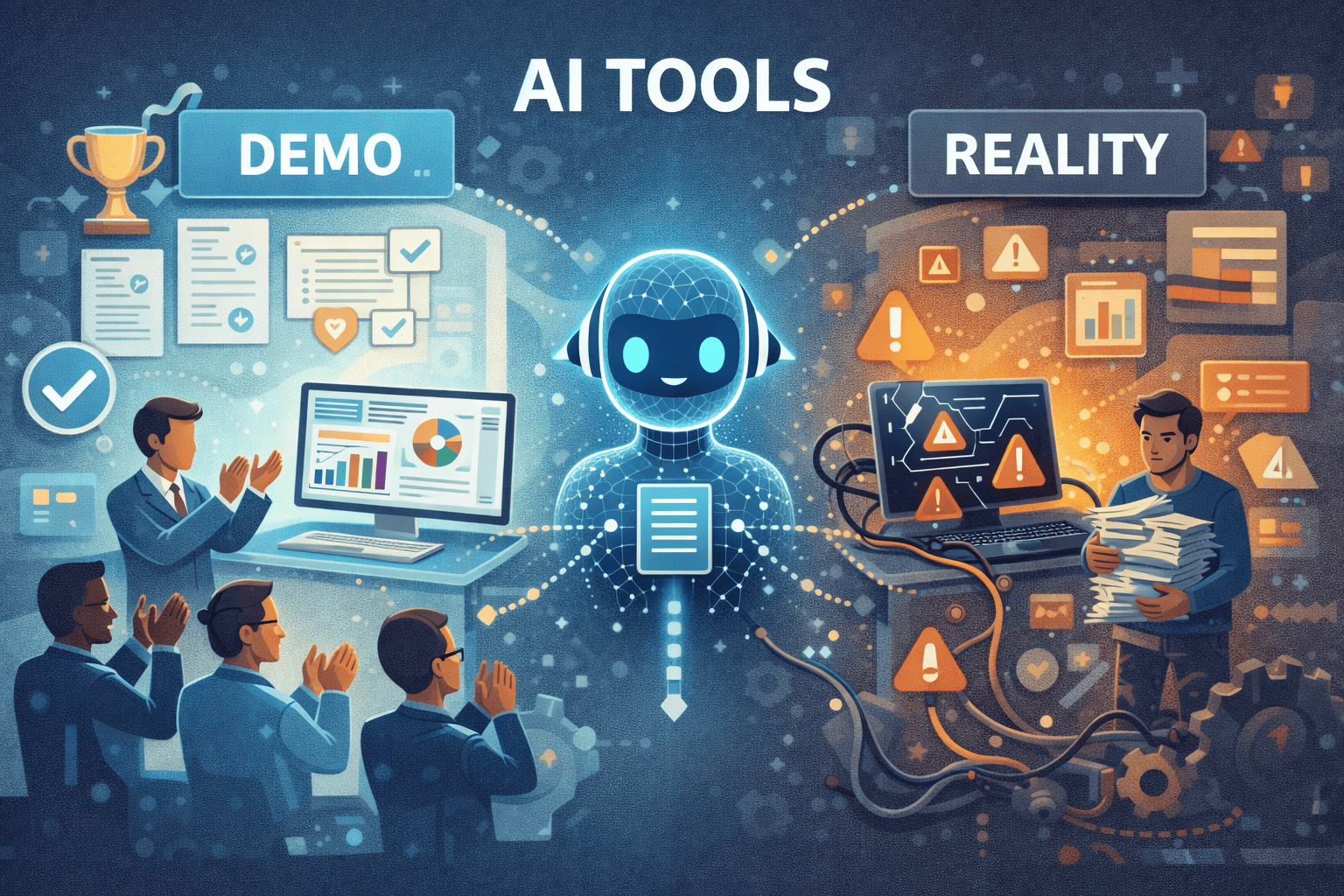
Polished interfaces, preloaded data, and carefully scripted workflows make almost any AI product look impressive in a controlled environment. The real challenge is not whether an AI tool can perform well in a demo, but whether it can survive real-world complexity.
This article explains how to evaluate AI tools realistically—without being misled by demos that optimize for presentation rather than long-term value.
Why AI Demos Are Structurally Misleading
Demos are designed to minimize uncertainty.
They usually rely on:
- Clean, well-structured input data
- Ideal use cases
- Pretrained examples
- Limited scope and duration
In contrast, real environments are messy. Inputs are inconsistent, edge cases dominate, and workflows evolve over time. The gap between demo performance and real performance is where most AI tools break down.
Understanding this gap is the first step toward better evaluation.
Shift the Question: From “What Can It Do?” to “What Happens After?”
Most evaluations focus on features.
A better approach is to ask:
- What happens after the initial output?
- How does the tool behave when inputs change?
- How much manual correction is required over time?
AI tools rarely operate in isolation. They exist inside workflows, systems, and decision chains. Evaluating them as standalone products misses their real impact.
This is the same mistake discussed in Why AI Automation Is Shifting from Tools to Systems, where local optimization creates global friction. This shift reflects a broader move away from isolated tools toward system-level design, where automation is evaluated based on outcomes rather than features.
Evaluate AI Tools in Context, Not Isolation
A critical evaluation step is testing how an AI tool fits into an existing workflow.
Ask:
- Where does the tool receive input from?
- Where does its output go?
- What decisions depend on that output?
If an AI tool produces impressive results but requires constant manual intervention downstream, its net value may be negative.
Strong tools reduce coordination overhead instead of shifting it elsewhere.
Look for Failure Behavior, Not Success Cases
Demos highlight best-case scenarios. Evaluations should focus on failure modes.
Key questions include:
- How does the system handle ambiguous input?
- What happens when confidence is low?
- Can outputs be inspected and corrected easily?
Tools that fail quietly are far more dangerous than tools that fail visibly. Silent errors compound over time and erode trust.
This is especially relevant in document-heavy workflows, where AI-driven document processing systems must escalate uncertainty instead of hiding it.
Measure Cognitive Load, Not Just Accuracy
Accuracy metrics alone are misleading.
A tool that produces 90% accurate results but requires constant supervision may increase cognitive load rather than reduce it. Over time, this leads to decision fatigue, even if individual outputs look correct.
Effective AI tools:
- Reduce the number of decisions humans must make
- Make uncertainty explicit
- Support quick review and override
This principle mirrors the argument in How AI Reduces Decision Fatigue in Knowledge Work: fewer micro-decisions lead to better long-term outcomes.
Test with Real Data and Real Constraints
Evaluation should always involve:
- Actual production data
- Incomplete or inconsistent inputs
- Time pressure and interruptions
If possible, test the tool in parallel with existing processes rather than replacing them immediately. Compare:
- Time spent
- Error rates
- Human intervention required
Short pilots reveal more than extended demos.
Beware of Feature Density
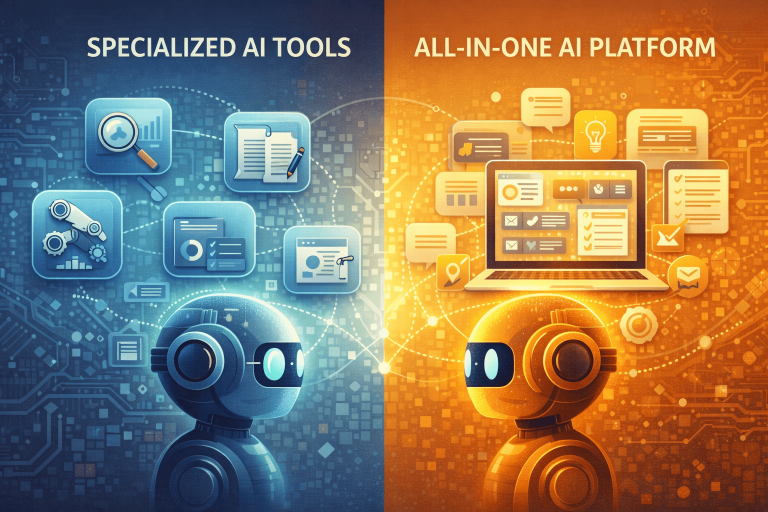
AI tools often bundle many features to appear comprehensive.
Instead of asking “How many features does this tool have?”, ask:
- Which features will actually be used?
- Which features introduce new decisions?
- Which features depend on ideal conditions?
Complex tools tend to fail in subtle ways. Simpler tools embedded in well-designed systems often outperform them.
This is why system-level design matters more than tool sophistication.
Evaluate Long-Term Adaptability
AI tools must operate in changing environments.
Important signals include:
- How models are updated
- Whether workflows can be adjusted without retraining
- How feedback loops are handled
Tools that cannot adapt gracefully become liabilities as workflows evolve. Evaluation should include questions about maintenance, not just onboarding.
Common Evaluation Mistakes
Organizations often fail by:
- Trusting demos over pilots
- Evaluating tools outside real workflows
- Ignoring cognitive overhead
- Confusing automation with reliability
AI tools should be judged by how well they reduce friction over time, not by how impressive they look initially.
Final Thoughts
Evaluating AI tools is not about spotting the smartest model. It is about understanding how a tool behaves under pressure.
Demos show potential. Real evaluation reveals cost.
The most reliable AI tools are not those with the best presentations, but those that integrate quietly into systems, surface uncertainty clearly, and reduce human effort where it matters most.
When evaluation shifts from features to systems, better decisions follow.