AI-Driven Document Processing: From Ingestion to Action
AI-driven document processing is no longer about extracting text from files. It has evolved into a system-level capability that transforms documents into decisions, workflows, and actions. As organizations handle increasing volumes of contracts, reports, invoices, and internal documents, manual processing has become a structural bottleneck.
The real shift is not automation of documents themselves, but automation of what happens after documents are understood.
Why Traditional Document Processing Breaks at Scale
Most document workflows still follow a linear pattern:
- A document is received
- Information is manually extracted
- Data is copied into another system
- Decisions are made downstream
This approach fails as volume and complexity increase. Documents are unstructured, inconsistent, and context-dependent. Even when OCR and basic extraction tools are used, humans are still responsible for interpretation, routing, and follow-up actions.
This is where AI-driven document processing changes the model entirely.
The Core Idea: Documents as Triggers, Not Artifacts
In modern systems, documents are no longer passive records. They become triggers.
An AI-driven document processing system treats every document as:
- An information source
- A context signal
- A potential action initiator
Instead of asking “What does this document say?”, the system asks:
“What should happen because this document exists?”
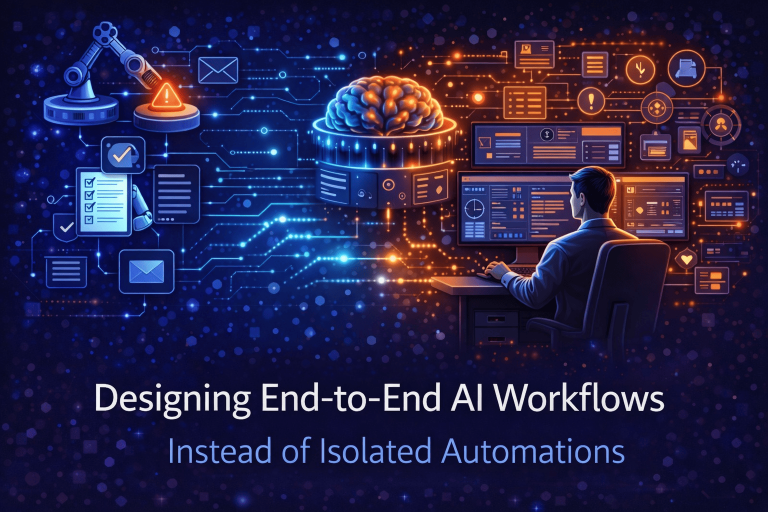
This shift mirrors the broader transition from isolated automation tools to end-to-end AI workflows, where understanding and action are tightly connected.
Stage 1: Intelligent Document Ingestion
The first stage is ingestion, but not in the traditional sense.
AI-driven ingestion focuses on:
- Identifying document type automatically
- Detecting source and intent
- Normalizing formats and structures
Rather than routing documents by folder or email address, AI classifies them by purpose. This reduces manual sorting and prepares documents for downstream processing without rigid rules.
Stage 2: Context-Aware Understanding
Extraction alone is not enough.
At this stage, AI:
- Identifies key entities and relationships
- Preserves contextual meaning
- Differentiates between similar-looking documents with different implications
This is where document processing intersects with broader knowledge systems. Documents are not isolated; they relate to projects, decisions, and historical data. Systems designed as isolated tools fail here because they lose context between steps.
This is the same limitation discussed in Designing End-to-End AI Workflows Instead of Isolated Automations, where disconnected automations struggle to scale reliably.
Stage 3: Decision Mapping and Routing
Once a document is understood, the system determines what should happen next.
Examples include:
- Escalating contracts above a risk threshold
- Triggering approval workflows
- Updating internal knowledge bases
- Initiating reporting or compliance actions
This stage is critical because it removes routine decisions from humans, reducing decision fatigue in document-heavy roles such as operations, finance, and legal teams.
The same principle applies as in How AI Reduces Decision Fatigue in Knowledge Work: fewer repetitive decisions lead to more consistent outcomes.
Stage 4: Action Execution Across Systems
AI-driven document processing only delivers value when it connects to execution.
At this stage, systems:
- Update internal tools automatically
- Trigger downstream workflows
- Notify stakeholders with context-aware summaries
This is where document processing stops being a feature and becomes infrastructure. Documents move seamlessly from ingestion to action without manual coordination.
Why AI-Driven Document Processing Works Where Tools Fail
Traditional tools focus on isolated steps:
- OCR
- Extraction
- Classification
AI-driven systems focus on continuity:
- Maintaining context across stages
- Preserving intent
- Coordinating actions across tools
This system-level approach aligns with the broader industry shift described in Why AI Automation Is Shifting from Tools to Systems. Documents are no longer endpoints — they are inputs into living workflows.
Common Mistakes in AI Document Automation
Organizations often struggle because they:
- Automate extraction without defining actions
- Treat documents as static records
- Add AI without redesigning workflows
- Remove humans too early from high-risk decisions
AI-driven document processing requires intentional design. Without clear action models, automation simply moves bottlenecks downstream.
When AI-Driven Document Processing Makes the Most Sense
This approach is especially effective when:
- Document volume is high
- Decisions depend on document content
- Multiple systems must be updated
- Manual routing creates delays
It is less valuable when documents are purely archival or rarely acted upon.
Final Thoughts
AI-driven document processing is not about smarter text extraction. It is about connecting understanding to action.
When documents are treated as triggers inside end-to-end systems, organizations eliminate coordination overhead, reduce decision fatigue, and improve consistency at scale. The real advantage comes not from better models, but from better system design.
Documents stop being work. They become signals.
That is the future of document automation.