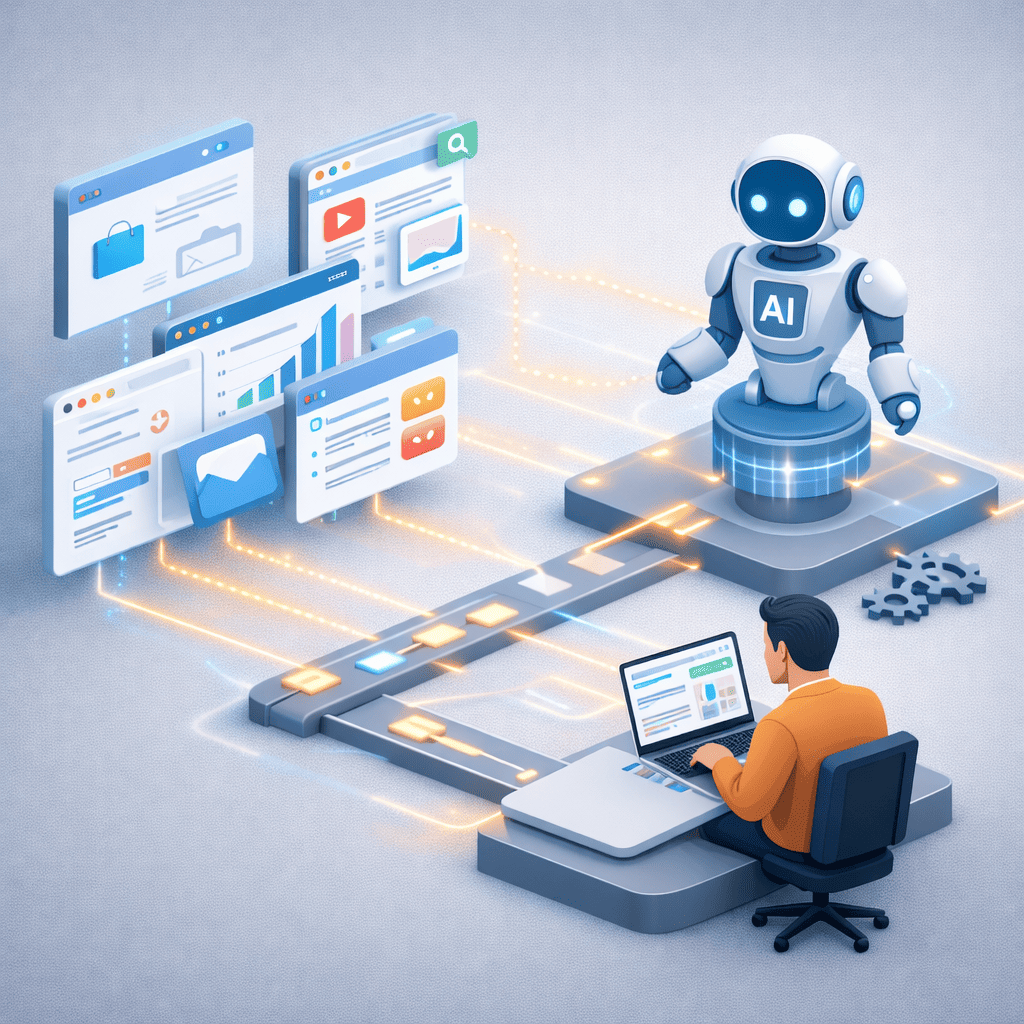

AI agents are not simply another layer on top of existing SaaS tools. They represent a structural shift in how software is used, coordinated, and experienced. For over a decade, organizations accumulated applications to solve discrete problems. Today, the direction is reversing: instead of managing tools, users are beginning to delegate outcomes.
The transition from SaaS sprawl to AI agents is not about convenience. It is about changing the architecture of work itself.
The Era of SaaS Sprawl
The SaaS model scaled because it modularized functionality. Need CRM? Buy one. Need project management? Add another. Need analytics? Subscribe again.
Over time, this led to:
- Tool fragmentation
- Context switching
- Duplicate data entry
- Integration complexity
- Rising subscription costs
Knowledge workers became coordinators of software rather than executors of outcomes. Each task required navigating multiple dashboards, exporting data, and manually connecting systems.
According to research from <a href=”https://www.mckinsey.com/capabilities/quantumblack/our-insights/the-state-of-ai” target=”_blank” rel=”dofollow”>McKinsey & Company</a>, the next wave of productivity gains will come not from isolated tools but from integrated AI systems embedded across workflows.
SaaS scaled horizontally. AI agents scale orchestrationally.
What Makes AI Agents Structurally Different
Traditional SaaS tools are interface-driven. You open an app and perform a task.
AI agents are outcome-driven. You define the objective, and the system determines:
- Which tools to access
- What data to retrieve
- What steps to execute
- How to structure the output
This shift changes the locus of control.
Instead of users navigating tools, AI agents navigate tools on behalf of users.
The structural differences include:
| SaaS Model | AI Agent Model |
|---|---|
| Tool-centric | Outcome-centric |
| Manual orchestration | Autonomous orchestration |
| User coordinates systems | Agent coordinates systems |
| Interface dependency | Intent dependency |
This is not an incremental improvement. It is an architectural reconfiguration.
From Tool Stacks to Orchestration Layers
In a SaaS environment, productivity depends on how well teams manage tool stacks. In an AI agent environment, productivity depends on how well agents orchestrate systems.
This introduces a new software layer:
The orchestration layer.
AI agents function as middleware intelligence that sits between the user and the application ecosystem.
Instead of:
User → App A → App B → App C
The model becomes:
User → AI Agent → Apps (automated execution)
This reduces cognitive load and reassigns coordination work to machine systems.
We previously examined how reliable AI workflows require human checkpoints to maintain governance. AI agents extend that principle into cross-platform automation.
Why SaaS Sprawl Became Unsustainable
SaaS sprawl was not accidental. It was a natural byproduct of specialization.
However, several pressures accelerated the shift:
1. Cognitive Overhead
Knowledge workers spend significant time navigating tools rather than producing value.
2. Integration Fragility
API connections break. Data schemas mismatch. Automations fail silently.
3. Cost Inflation
As tool stacks expand, subscription costs compound without proportional productivity gains.
4. Fragmented Context
No single tool contains full situational awareness.
AI agents address these structural inefficiencies by centralizing coordination logic.
Governance in the Age of AI Agents
Replacing SaaS coordination with AI agents introduces new governance requirements.
Autonomous orchestration creates:
- Escalation risk
- Error propagation
- Decision opacity
- Accountability ambiguity
This is why human-in-the-loop models remain essential.
AI agents should:
- Execute routine tasks autonomously
- Escalate ambiguous decisions
- Log actions transparently
- Allow override mechanisms
The shift is not from human to machine. It is from manual orchestration to supervised orchestration.
Implications for Knowledge Work
For knowledge workers, the transition from SaaS sprawl to AI agents changes daily operations.
Instead of:
- Opening multiple dashboards
- Copying data between systems
- Managing notification streams
Workers define objectives:
“Prepare a competitive analysis.”
“Generate weekly performance summary.”
“Draft response to client based on CRM history.”
The AI agent:
- Retrieves data
- Structures information
- Drafts output
- Suggests next actions
Humans validate, refine, and decide.
The cognitive role moves upward—from coordination to judgment.
Strategic Impact on Software Vendors
This structural change affects software companies as well.
SaaS vendors must decide whether they will:
- Remain standalone utilities
- Become agent-compatible modules
- Build proprietary agents
- Provide orchestration APIs
The competitive landscape shifts from feature breadth to interoperability depth.
Software that cannot integrate into agent ecosystems risks marginalization.
Risks of Premature Autonomy
While AI agents promise simplification, premature autonomy can create systemic risk.
Common pitfalls include:
- Over-delegation of strategic decisions
- Insufficient monitoring
- Lack of audit trails
- Weak escalation logic
Organizations should adopt a staged model:
Stage 1: Assisted execution
Stage 2: Conditional autonomy
Stage 3: Supervised orchestration
Skipping governance design invites failure.
The Structural Change in Software
The movement from SaaS sprawl to AI agents reflects a deeper transformation:
From tools as destinations
To intelligence as mediator
From interface navigation
To intend delegation
From fragmented productivity
To orchestrated execution
This shift does not eliminate software. It reorganizes it around the agency rather than the application.
Conclusion
AI agents represent a structural change in software architecture, not merely an efficiency upgrade.
SaaS sprawl fragments workflows. AI agents re-centralize coordination.
The long-term advantage will belong to organizations that:
- Design orchestration layers intentionally
- Embed human oversight strategically
- Treat AI agents as infrastructure
- Maintain governance alongside automation
Software is no longer just a collection of tools. It is becoming an intelligent system that executes intent.
The companies that adapt to this structural shift will define the next decade of knowledge work.