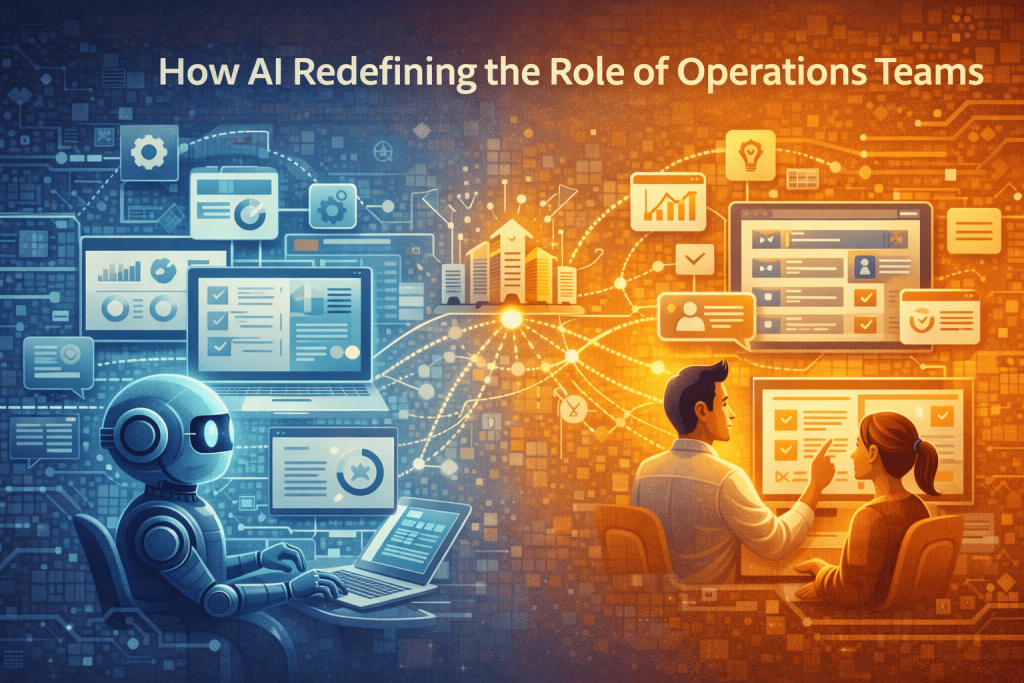

Operations teams have traditionally been responsible for coordination, execution oversight, and process stability. Their work ensured that systems ran efficiently, deadlines were met, and communication gaps were minimized. Today, AI is redefining operations teams by shifting their focus from manual coordination to intelligent system design.
The role of operations teams is no longer centered on managing tasks. It is increasingly about managing systems.
Why Operations Teams Historically Focused on Control
Operational functions emerged to bring structure to growing organizations. As workflows expanded, someone needed to:
- standardize processes
- document procedures
- monitor performance
- resolve bottlenecks
- ensure accountability
This model worked well in stable environments where inputs were predictable, and workflows followed defined patterns.
However, modern organizations operate in dynamic, data-heavy environments. Manual coordination struggles to scale with complexity.
The Shift from Process Management to System Orchestration
AI introduces a structural change.
Instead of monitoring workflows manually, operations teams now oversee AI-driven systems that:
- automate data routing
- flag anomalies
- predict bottlenecks
- prioritize work dynamically
The shift is subtle but fundamental.
Operations teams are moving from process enforcement to system orchestration.
Rather than asking, “Is this task completed?” teams ask, “Is the system producing the right outcomes?”
AI Reduces Operational Friction
One of the most immediate impacts of AI on operations teams is the reduction of friction.
AI can:
- synchronize cross-functional data
- surface real-time metrics
- detect inconsistencies
- automate repetitive coordination
This eliminates many of the manual check-ins and follow-ups that historically consumed operational bandwidth.
When well designed, AI-driven systems reduce decision fatigue by narrowing the set of issues that truly require human judgment.
From Reporting to Decision Systems
Operations teams have long relied on dashboards and reports. These tools provide visibility but often require manual interpretation and action.
AI shifts operations from static reporting to dynamic decision systems.
Instead of generating weekly reports, AI systems:
- monitor signals continuously
- trigger alerts proactively
- recommend corrective actions
- escalate risks automatically
This transition mirrors the broader movement toward system-level design rather than isolated automation.
Operations Teams as System Designers
As AI absorbs repetitive monitoring and coordination, the role of operations teams evolves.
They increasingly focus on:
- defining system rules
- setting escalation boundaries
- designing workflows
- aligning automation with business goals
- ensuring data integrity
In this model, operations professionals become architects of intelligent infrastructure rather than managers of manual processes.
This aligns closely with the shift described in Why AI Automation Is Shifting from Tools to Systems, where outcomes matter more than interfaces.
The Risk of Over-Automation
AI does not eliminate operational risk. In fact, poorly designed systems can amplify it.
Over-automation may lead to:
- reduced transparency
- unclear ownership
- hidden decision logic
- blind trust in automation
Operations teams play a critical role in preventing this.
They must ensure that:
- AI systems remain explainable
- decision pathways are auditable
- humans remain in the loop when necessary
Without this oversight, automation can introduce fragility rather than resilience.
Skills Operations Teams Must Develop
As AI becomes embedded in operational workflows, skill requirements change.
Modern operations teams must understand:
- data structures
- automation logic
- system integration
- AI tool evaluation
- workflow design
This does not mean every operations professional must become a data scientist. It means they must become system thinkers.
Evaluating AI tools based on long-term interoperability rather than feature lists becomes essential.
Collaboration Between AI and Human Judgment
AI excels at:
- pattern detection
- data synthesis
- anomaly identification
- routine prioritization
Humans excel at:
- strategic interpretation
- contextual nuance
- ethical judgment
- trade-off analysis
Operations teams now operate at the intersection of these strengths.
The goal is not full automation. It is intelligent augmentation.
When AI Transforms Operations Most Effectively
AI delivers the strongest impact in operations environments where:
- data flows across multiple systems
- coordination costs are high
- workflows are repeatable but context-sensitive
- decision speed affects outcomes
In these settings, AI reduces noise and increases clarity.
But transformation only occurs when automation is implemented as part of a coherent system, not as scattered tool adoption.
The Future of Operations Teams
The operations function is not shrinking. It is becoming more strategic.
AI frees operations teams from reactive coordination and enables them to focus on:
- system resilience
- performance optimization
- cross-functional alignment
- continuous improvement
In this new paradigm, operations teams become the custodians of intelligent systems.
They ensure that automation serves business intent rather than obscuring it.
Final Thoughts
AI is redefining operations teams not by replacing them, but by elevating their responsibilities.
The future of operations is not about managing tasks.
It is about designing adaptive systems that align execution with strategy.
Organizations that understand this shift will not view AI as a cost-saving tool. They will treat it as infrastructure.
And operations teams will be at the center of that transformation.