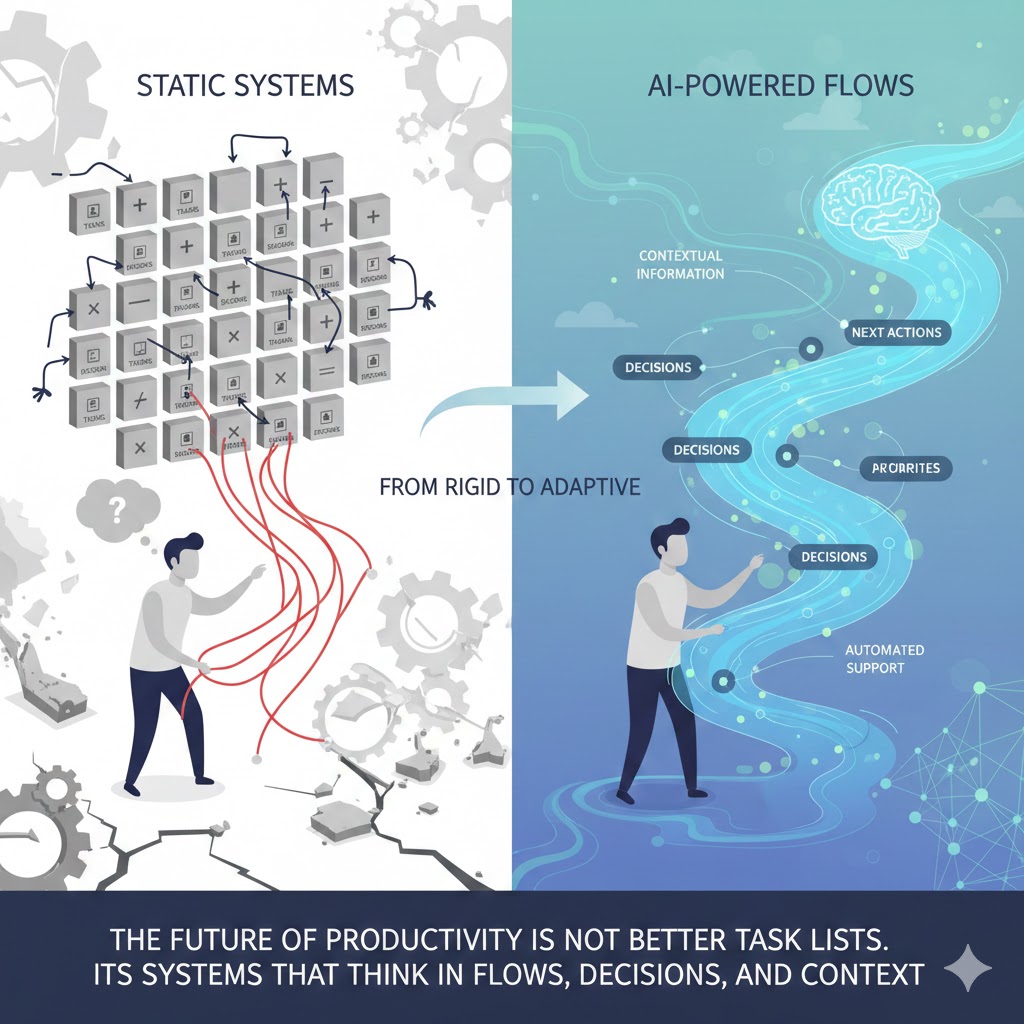

Productivity systems are designed to bring order to work. In practice, many of them quietly fail. Task managers, planning frameworks, and productivity methodologies often start strong but gradually lose relevance as real work becomes more complex and less predictable.
The failure is rarely caused by a lack of discipline or poor tools. It is caused by a mismatch between static systems and dynamic work.
The Core Problem: Productivity Systems Are Too Rigid
Most productivity systems assume that work is:
- predictable
- stable over time
- driven by clear priorities
In reality, knowledge work is interrupt-driven, context-dependent, and constantly changing. Static systems struggle to keep up.
As a result, systems require frequent manual updates. Over time, maintaining the system becomes work itself — and the system stops being trusted.
Productivity Systems Optimize Tasks, Not Decisions
Traditional productivity systems focus on managing tasks:
- capturing them
- categorizing them
- scheduling them
What they often ignore is decision-making.
Knowledge workers do not fail because they forget tasks. They fail because they face too many small decisions every day: what to do first, what to defer, what to ignore. This leads directly to decision fatigue, even when systems are in place.
When Systems Become Another Source of Cognitive Load
A common symptom of failing productivity systems is increased mental overhead.
Instead of reducing complexity, systems:
- introduce multiple views and filters
- require constant prioritization
- demand regular reviews
This shifts effort from doing work to managing representations of work. The system no longer supports productivity — it competes with it.
This mirrors the broader issue discussed in The Hidden Cost of Over-Automation in Knowledge Work, where tools intended to help quietly increase cognitive load.
Why Manual Systems Do Not Scale With Complexity
As responsibilities grow, productivity systems must handle:
- more inputs
- more dependencies
- more uncertainty
Manual systems break under this pressure. They rely on humans to:
- keep everything up to date
- maintain context across tools
- notice conflicts early
At scale, this becomes unsustainable. The system may still exist, but it no longer reflects reality.
How AI Changes the Nature of Productivity Systems
AI does not fix productivity by adding more features. It fixes it by changing what systems do.
AI-powered productivity systems:
- adapt priorities dynamically
- surface relevant context automatically
- reduce routine decisions
- react to changes instead of requiring manual updates
Instead of asking users to maintain the system, the system maintains itself.
This is part of the broader shift from tools to systems, where coordination matters more than interfaces.
AI Systems Focus on Flow, Not Lists
Effective AI-driven productivity systems focus on workflow rather than static task lists.
They work by:
- monitoring signals (time, context, workload)
- suggesting next actions
- identifying overload or conflicts
- escalating only when human judgment is needed
This aligns with end-to-end AI workflows, where value comes from continuity rather than isolated optimizations.
Why AI-Based Systems Actually Stick
Productivity systems fail when they require constant attention.
AI-based systems succeed when they:
- fade into the background
- reduce visible complexity
- support decisions quietly
- adapt without frequent reconfiguration
This is why AI-powered systems often feel less “feature-rich” but more effective over time.
Common Mistakes When Applying AI to Productivity
AI does not automatically fix broken systems.
Common pitfalls include:
- automating existing rigid workflows
- removing humans entirely from decision loops
- adding AI as another interface
When AI is layered on top of flawed systems, failure accelerates instead of disappearing.
Designing Productivity Systems That Work With Humans
The goal of productivity systems is not control. It is alignment.
Effective systems:
- respect human attention
- reduce unnecessary decisions
- preserve context
- support judgment instead of replacing it
This people-first approach is consistent with Google’s guidance on building helpful systems, which emphasizes trust, clarity, and long-term usefulness over short-term optimization.
Final Thoughts
Productivity systems fail not because people are undisciplined, but because work is complex.
AI improves productivity systems by absorbing complexity rather than pushing it onto humans. When systems adapt to reality rather than forcing reality to adapt to them, productivity becomes sustainable.
The future of productivity is not better task lists.
It is systems that think in flows, decisions, and context.