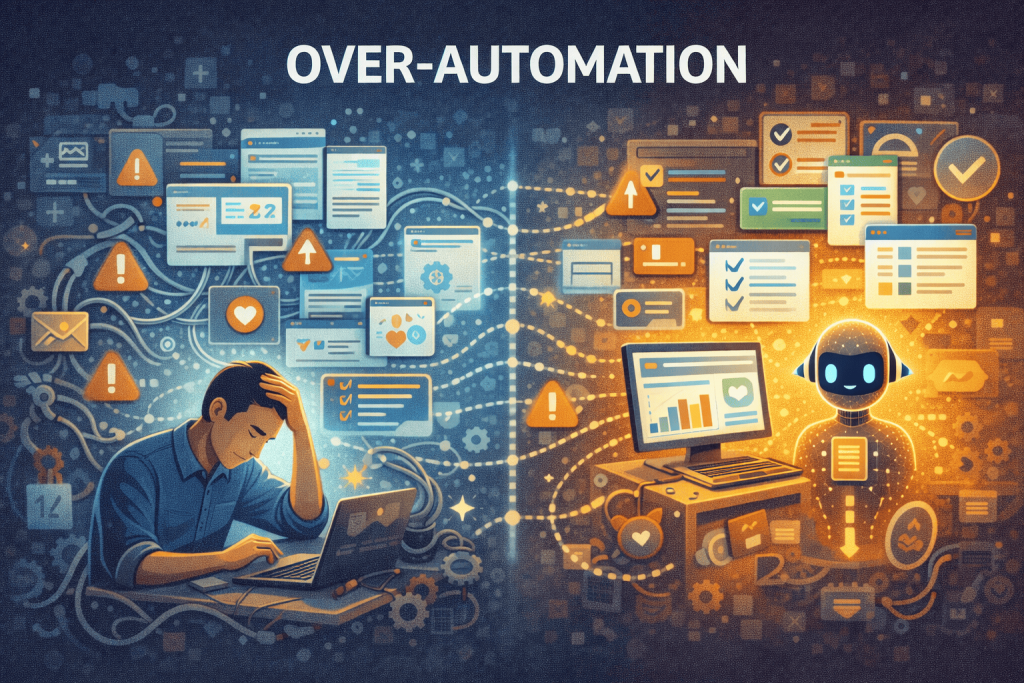

Over-automation in knowledge work is often framed as progress. More tools, more workflows, and more automation layers are assumed to lead to higher efficiency. In practice, the opposite frequently happens. When automation expands without system-level design, it quietly increases cognitive load, fragments responsibility, and erodes decision quality.
The real cost of over-automation is not technical. It is human.
Why Automation Success Often Turns Into Friction
Automation usually starts with good intentions.
Teams automate:
- repetitive tasks
- data movement
- notifications and triggers
- routine decisions
Individually, these automations work. Collectively, they create complex systems that few people fully understand. As workflows grow, so does the effort required to monitor, override, and maintain them.
This is how productivity gains slowly turn into operational drag.
The Difference Between Automation and System Design
Automation answers the question:
“How do we remove this task?”
System design asks:
“How should work flow end to end?”
Over-automation happens when tasks are removed without redesigning the surrounding workflow. Each automation optimizes a local problem but introduces global complexity. Context gets lost between steps, and humans are left to reconnect the pieces.
This is the same structural issue described in Why AI Automation Is Shifting from Tools to Systems, where isolated optimizations fail to scale.
Cognitive Load Increases Even When Work Decreases
One of the least visible effects of over-automation is increased cognitive overhead.
Knowledge workers must:
- remember which systems act automatically
- monitor silent background processes
- decide when to intervene
- resolve conflicts between automations
Even when fewer tasks are performed manually, the mental effort required to supervise automation grows. This leads directly to decision fatigue, especially in roles that depend on judgment rather than execution.
When Automation Removes Ownership
Over-automation blurs responsibility.
When something goes wrong:
- no one knows which automation caused it
- fixes require cross-tool debugging
- accountability becomes unclear
Knowledge work depends on ownership and understanding. Systems that act autonomously without clear escalation paths weaken both. Automation should support human decision-making, not obscure it.
The Illusion of Efficiency Metrics
Over-automation often looks successful on dashboards.
Metrics improve:
- tasks completed
- processing time
- throughput
But these metrics rarely capture:
- time spent diagnosing failures
- effort required to maintain trust
- loss of situational awareness
As discussed in How to Evaluate AI Tools Without Falling for Demos, systems that look efficient in controlled environments often fail under real-world complexity.
Automation Should Reduce Decisions, Not Create New Ones
The most effective automation systems share one trait: they reduce the number of decisions humans must make.
Over-automation does the opposite. It introduces:
- configuration choices
- exception handling
- rule conflicts
- unclear boundaries
Well-designed systems remove routine decisions while preserving meaningful ones. Poorly designed automation shifts decision-making into less visible, more stressful forms.
Signs You Are Over-Automating
Over-automation rarely feels dramatic. Warning signs include:
- frequent “why did this happen?” moments
- increasing documentation just to explain workflows
- reliance on dashboards instead of understanding
- hesitation to modify systems due to fear of breakage
When automation becomes fragile, it stops being leveraged and starts being a liability.
Designing for Human-Centered Automation
The solution is not less automation, but better design.
Effective systems:
- operate around goals, not tasks
- preserve context across steps
- surface uncertainty clearly
- escalate decisions intentionally
This aligns with the principles behind end-to-end AI workflows, where coordination and clarity matter more than the number of automated actions.
The solution is not less automation, but better design. Human-centered automation prioritizes clarity, accountability, and decision support over raw efficiency. For broader guidance on building reliable, people-first automation systems, Google’s guidance on building helpful systems provides a solid reference point.
When Automation Actually Helps Knowledge Work
Automation delivers real value when:
- work is repeatable but context-sensitive
- decision criteria are stable
- human review remains lightweight
- systems adapt gradually
In these conditions, automation fades into the background instead of demanding constant attention.
Final Thoughts
The hidden cost of over-automation is not inefficiency. It is an erosion of understanding.
Knowledge work depends on context, judgment, and trust. Automation that ignores these dimensions creates systems that look productive while quietly undermining the people who rely on them.
The goal is not maximum automation.
The goal is sustainable clarity.