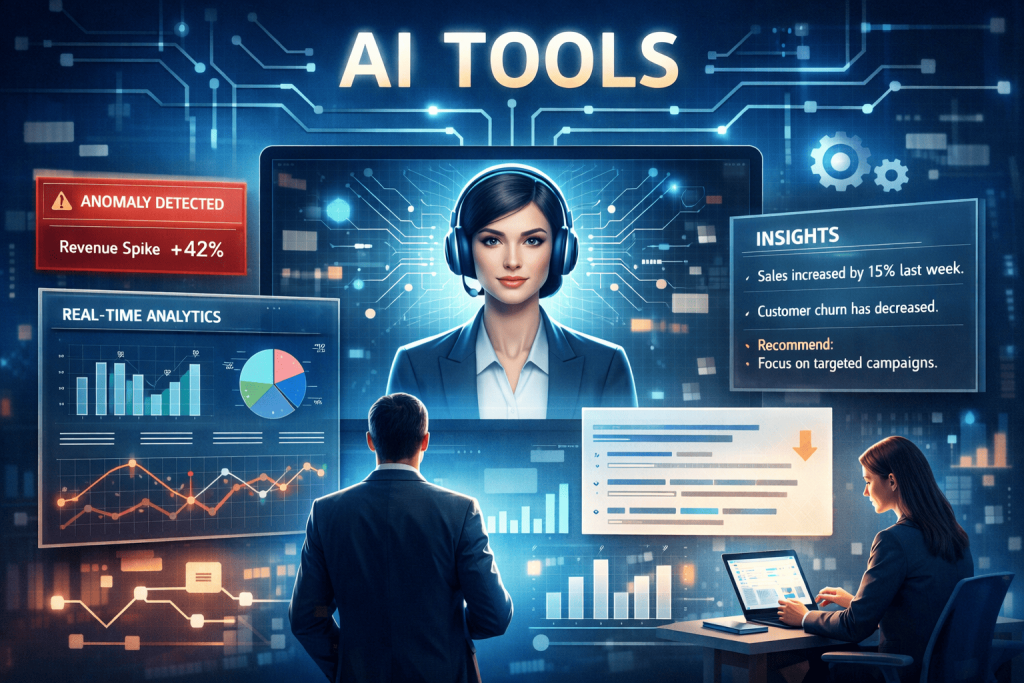

AI tools are replacing manual reporting because static reports no longer scale with modern data-driven workflows. It exists not because it is effective, but because it is familiar. Spreadsheets, dashboards, and recurring reports give the impression of control, while quietly consuming time, attention, and cognitive energy.
By 2026, this compromise is breaking down.
AI tools are no longer assisting reporting workflows. They are replacing manual reporting entirely, shifting the role of reports from static artifacts to continuously running systems.
This article explains why manual reporting is becoming obsolete, what replaces it, and how AI-driven reporting tools are changing how organizations understand and act on data.
Why Manual Reporting No Longer Scales
Manual reporting fails for structural reasons, not human ones.
Typical reporting workflows involve:
- Collecting data from multiple sources
- Cleaning and normalizing it
- Building charts and tables
- Interpreting results
- Distributing reports on a schedule
Each step introduces a delay. By the time a report is reviewed, the underlying data has often changed.
As organizations grow, reporting complexity increases faster than reporting capacity. More tools, more metrics, more stakeholders — but still the same manual process.
The result is predictable:
- Reports arrive late
- Insights are outdated
- Decisions rely on intuition instead of data
- Analysts spend more time maintaining reports than analyzing outcomes
AI tools target this structural inefficiency directly.
This aligns with broader guidance on building systems that support data-driven decisions rather than static outputs, as outlined in Google’s documentation on creating helpful, people-first content.
The Shift From Reports to Reporting Systems
The key change in 2026 is conceptual.
Instead of asking:
“How do we build this report?”
Teams ask:
“What decisions should this data support?”
This transition is driven by specialized AI tools for data analysis that operate continuously and support decisions instead of producing static reports.
AI-driven reporting tools are built around decision contexts, not documents. They operate continuously, updating insights as data changes, rather than producing snapshots on fixed schedules.
This shift removes the need for most manual reporting altogether.
Category 1: AI Tools for Automated Metric Definition
One of the most time-consuming aspects of reporting is defining metrics.
AI tools now:
- Infer key metrics from business context
- Detect redundant or misleading KPIs
- Align metrics across teams automatically
- Track changes in definitions over time
Instead of debating which numbers matter, teams start from shared, AI-maintained definitions.
This reduces reporting friction before any visualization is created.
Category 2: AI-Powered Data Monitoring and Anomaly Detection
Manual reports are reactive. AI tools are continuous.
Modern AI reporting systems:
- Monitor data streams in real time
- Detect anomalies automatically
- Identify trend shifts early
- Surface only what requires attention
Rather than reviewing dozens of charts, decision-makers receive contextual alerts when something meaningful changes.
Reporting becomes event-driven, not calendar-driven.
Category 3: Natural Language Reporting and Summaries
Dashboards still require interpretation.
AI tools increasingly replace visual-heavy reports with:
- Plain-language summaries
- Context-aware explanations
- Decision-focused narratives
Instead of reading charts, users read insights:
- What changed
- Why it matters
- What actions are recommended
This reduces dependency on analysts as translators and accelerates decision cycles.
Category 4: AI Tools That Connect Insights to Actions
Traditional reporting stops at information.
AI-driven reporting systems continue into execution:
- Trigger workflows when thresholds are crossed
- Recommend next steps based on historical outcomes
- Log decisions and results for future learning
This closes the loop between data and action.
Reporting becomes part of operations, not a separate activity.
Category 5: Self-Maintaining Dashboards (or the End of Dashboards)
Dashboards are not disappearing, but their role is shrinking.
AI tools now:
- Build dashboards automatically
- Adapt visualizations as data evolves
- Remove unused metrics
- Adjust views based on user behavior
In many cases, dashboards become secondary. Users rely on summaries, alerts, and contextual insights instead.
Manual dashboard maintenance becomes unnecessary.
Why AI Reporting Tools Work Where BI Failed
Traditional BI tools promised automation but delivered configuration.
They required:
- Manual setup
- Constant maintenance
- Dedicated specialists
AI reporting tools differ in one critical way: they adapt.
They learn from:
- How data is used
- Which insights lead to action
- Which reports are ignored
Over time, the system improves without continuous reconfiguration.
This is why AI tools replace reporting rather than optimizing it.
What Still Requires Human Judgment
AI does not eliminate responsibility.
Humans remain essential for:
- Defining strategic goals
- Evaluating trade-offs
- Interpreting ambiguous signals
- Making final decisions
The difference is that humans no longer spend time assembling information. They spend time thinking about it.
This is the real productivity gain.
Common Misconceptions About AI Reporting
- “We still need reports for compliance.”
AI systems can generate compliant outputs automatically, without manual preparation. - “AI reporting removes transparency.”
Well-designed systems log decisions, assumptions, and data sources more clearly than manual reports. - “This only works for large organizations.”
Smaller teams benefit even more because reporting overhead is proportionally higher.
How to Transition Away From Manual Reporting
Replacing manual reporting is a gradual process.
A practical approach:
- Identify reports that drive no decisions
- Replace scheduled reports with alerts
- Introduce AI summaries alongside dashboards
- Connect insights to workflows
- Retire reports that no one reads
The goal is not to automate reports, but to make them unnecessary.
Final Thoughts
In 2026, reporting is no longer about presenting data. It is about maintaining awareness.
AI tools replace manual reporting not by being faster, but by being continuous, contextual, and connected to action.
The organizations that benefit most will not be the ones with the most dashboards, but the ones where decisions happen naturally as data changes — without waiting for the next report.
That is when reporting stops being a task and becomes infrastructure.


