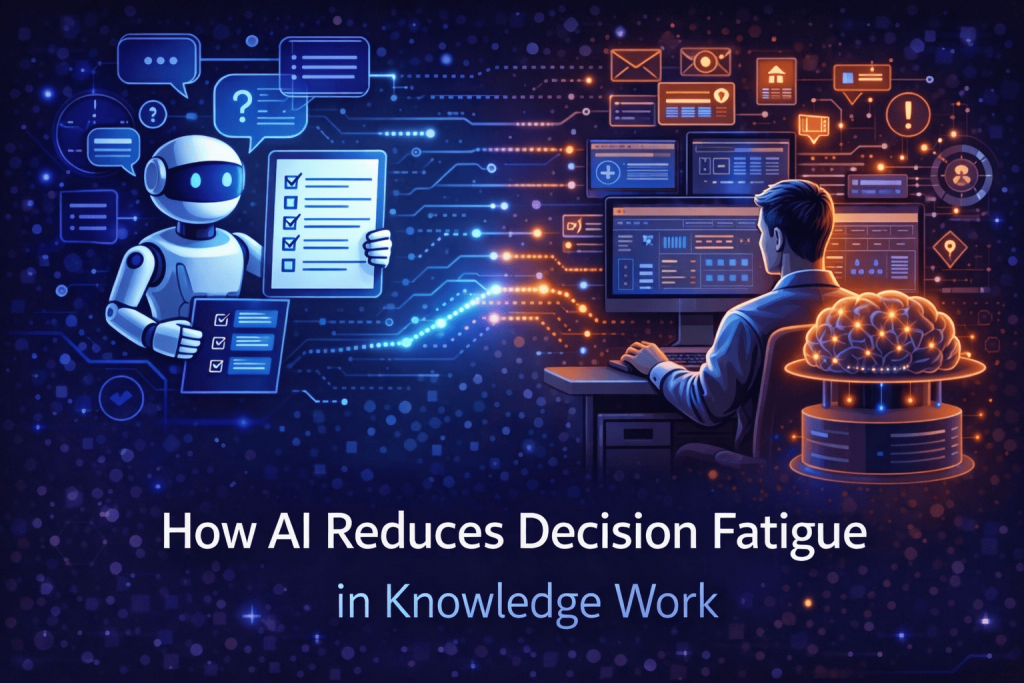

Decision fatigue is one of the least visible productivity problems in knowledge work. It does not show up as missed deadlines or obvious mistakes. Instead, it quietly erodes focus, slows execution, and makes even simple tasks feel heavier than they should.
AI is often framed as a tool for speed. In practice, its most valuable contribution to knowledge work is something else: reducing the number of decisions humans have to make each day.
This article explains how decision fatigue emerges, why it is especially damaging in cognitive work, and how AI can reduce it at the system level.
What Decision Fatigue Really Looks Like in Knowledge Work
Decision fatigue is not about big strategic choices. It comes from small, repetitive decisions that accumulate throughout the day:
- What should I work on first?
- Is this email urgent or not?
- How should I respond to this message?
- Where did I store that information?
- Should I handle this now or later?
Individually, these decisions feel trivial. Collectively, they drain mental energy. By mid-day, people are no less skilled — they are simply less capable of choosing well.
Knowledge work amplifies this problem because:
- Tasks are rarely identical
- Context switches are constant
- Work is abstract, not procedural
- There is no clear “done” state
The brain stays engaged long after the workday ends.
Why Traditional Productivity Advice Fails Here
Most productivity advice focuses on habits: better planning, stronger discipline, improved focus.
That approach assumes decision fatigue is a personal weakness. It is not.
The real issue is decision volume, not motivation. You cannot will yourself out of making hundreds of small decisions per day if the system keeps generating them.
This is where AI becomes useful — not as a motivator, but as a decision-reduction layer.
How AI Reduces Decisions Instead of Speeding Them Up
AI reduces decision fatigue by removing choices before they reach the human.
This happens in three main ways.
1. Turning Choices Into Defaults
Many decisions exist only because no default was defined.
AI systems can enforce defaults such as:
- Daily task prioritization
- Meeting note structure
- Response templates
- Content formats
- Review cycles
Instead of asking “what should I do next?”, the system already has an answer.
The human can override it — but no longer has to generate it from scratch.
This shift alone removes dozens of decisions per day.
2. Pre-Processing Information Before Humans See It
Raw information creates decisions.
AI can:
- Categorize emails before they are opened
- Summarize documents before reading
- Highlight key points automatically
- Flag anomalies and priorities
When information arrives pre-structured, humans no longer decide how to interpret it. They decide whether to engage with it at all.
This preserves cognitive energy for work that actually requires judgment.
3. Separating Judgment From Execution
Decision fatigue spikes when people mix thinking and doing.
AI allows these to be separated:
- Humans define rules, constraints, and goals
- AI handles execution within those boundaries
For example:
- AI drafts responses
- Humans approve or adjust
- AI schedules follow-ups
This reduces the emotional weight of decisions. Reviewing is easier than creating.
The Compounding Effect of Fewer Decisions
The biggest benefit is not time saved. It is mental consistency. When routine decisions are removed from daily workflows, productivity improvements compound over time, as seen in AI-driven habits that eliminate unnecessary choices.
When decision load decreases:
- Focus lasts longer
- Errors decline
- Context switching becomes less expensive
- Work feels lighter without becoming slower
This creates a compounding effect. Fewer decisions today lead to better decisions tomorrow.
Where AI Should Not Reduce Decisions
Not all decisions should be automated.
High-impact areas still require human judgment:
- Strategic direction
- Ethical considerations
- Creative synthesis
- Final accountability
Effective systems are explicit about this boundary. AI reduces noise, not responsibility.
Designing AI Systems for Decision Reduction
The mistake many teams make is deploying AI without redefining workflows.
To reduce decision fatigue, AI systems must:
- Be consistent
- Be predictable
- Use stable inputs
- Operate with clear scopes
Unpredictable AI increases cognitive load instead of reducing it.
The goal is boring reliability, not impressive intelligence.
Why This Matters More Than Productivity Metrics
Burnout rarely comes from too much work. It comes from too many decisions without recovery.
By reducing decision volume, AI:
- Protects attention
- Preserves judgment quality
- Makes sustainable productivity possible
This is especially important in knowledge work, where performance depends on thinking, not output volume.
Final Thoughts
AI’s real productivity advantage is not speed. It is cognitive relief.
When systems absorb routine decisions, humans regain the capacity to think clearly, focus deeply, and choose deliberately.
In the long run, the teams that benefit most from AI will not be the fastest. They will be the ones who make fewer unnecessary decisions every day.
That is how AI reduces decision fatigue — not by pushing people harder, but by letting them think less about the wrong things.


