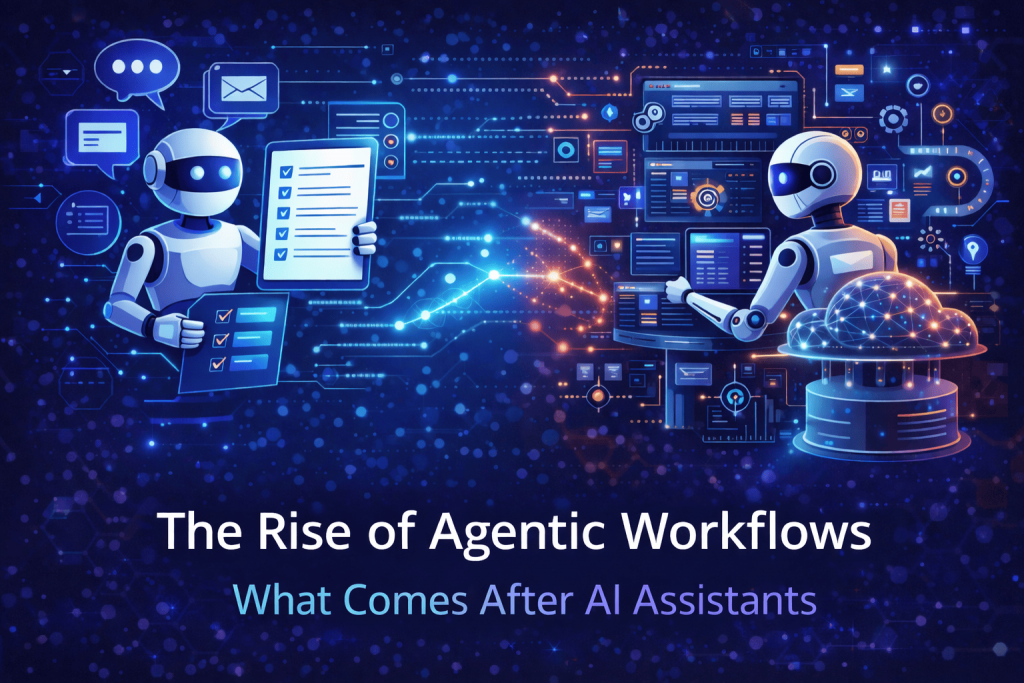

AI assistants were an important step forward. They helped users write faster, summarize information, and automate small tasks. But assistants were never designed to change how work is structured. They sit next to workflows, not inside them.
Agentic workflows represent a deeper shift. Instead of helping users do work, they are designed to run parts of the work themselves. This is not an incremental improvement. It is a structural change in how digital work is organized.
From Assistance to Agency
AI assistants are reactive by design.
They wait for prompts, respond to instructions, and operate within clearly defined boundaries. Even when they feel proactive, they are still dependent on constant human input.
Agentic workflows change that model.
An agentic system:
- Has a defined goal
- Operates across multiple steps
- Makes decisions based on context
- Takes actions without continuous prompting
- Adjusts behavior based on outcomes
The key difference is agency. These systems do not just respond; they act.
Why AI Assistants Are Reaching Their Limits
The assistant model breaks down as complexity increases.
In real workflows:
- Tasks depend on each other
- Information arrives asynchronously
- Decisions require historical context
- Errors compound over time
AI assistants struggle here because they lack:
- Persistent memory
- Workflow ownership
- Decision accountability
- Feedback loops
As a result, humans remain responsible for coordination. The assistant may help, but the user still manages the system.
Agentic workflows shift that responsibility.
What Defines an Agentic Workflow
An agentic workflow is not a single tool. It is a system architecture.
Core characteristics include:
- Clear objectives rather than isolated tasks
- State awareness across steps
- Event-driven execution
- Human-in-the-loop checkpoints
- Continuous monitoring and adjustment
Instead of asking an AI to “help with email,” an agentic workflow manages communication end-to-end: categorization, prioritization, drafting, follow-ups, and escalation.
The human role moves from execution to supervision.
Why This Shift Is Happening Now
Three conditions made agentic workflows viable.
First, AI models became reliable enough to handle ambiguity without constant correction.
Second, tooling matured around orchestration, not just generation. Systems can now connect data sources, trigger actions, and log outcomes.
Third, organizations reached the limits of SaaS sprawl. Managing dozens of disconnected tools created friction that automation alone could not solve.
Agentic workflows reduce tool dependence by operating across systems rather than inside them.
The Impact on Software and SaaS
Agentic workflows challenge the traditional SaaS model.
Instead of:
- Opening an app
- Performing a task
- Moving to the next tool
Users define outcomes, and agents decide:
- Which systems to use
- What data to pull
- What actions to take
- When to involve humans
This does not eliminate SaaS, but it changes its role. Tools become infrastructure, not interfaces.
The interface shifts from dashboards to intent.
New Risks Introduced by Agentic Systems
The agency introduces responsibility.
Poorly designed agentic workflows can:
- Amplify errors quickly
- Act on outdated assumptions
- Obscure accountability
- Create trust issues
This is why successful implementations emphasize:
- Narrow scopes
- Explicit constraints
- Auditability
- Human override points
Agentic workflows are powerful precisely because they act independently. That power must be bounded.
How Human Roles Are Changing
As the agency increases, human work changes shape.
Instead of:
- Executing tasks
- Monitoring every step
- Managing handoffs
Humans focus on:
- Defining objectives
- Setting constraints
- Reviewing outcomes
- Improving systems
This mirrors shifts seen in other domains, such as manufacturing automation. The work does not disappear; it moves up a level.
What Comes After AI Assistants
AI assistants are not going away. They become one component inside larger systems.
The future stack looks like this:
- AI assistants handle interaction and explanation
- Agents handle execution and coordination
- Humans handle goals, ethics, and accountability
The center of gravity moves from “using tools” to “designing systems.”
This is why agentic workflows matter. They represent the moment when AI stops being a feature and starts becoming infrastructure.
Final Thoughts
The rise of agentic workflows is not about smarter AI. It is about reorganizing work around autonomy.
Organizations that treat agents as assistants will see limited gains. Those who treat them as operational systems will unlock entirely new ways of working.
What comes after AI assistants is not another interface. It is a new layer of agency embedded into workflows themselves.
That shift is already underway.