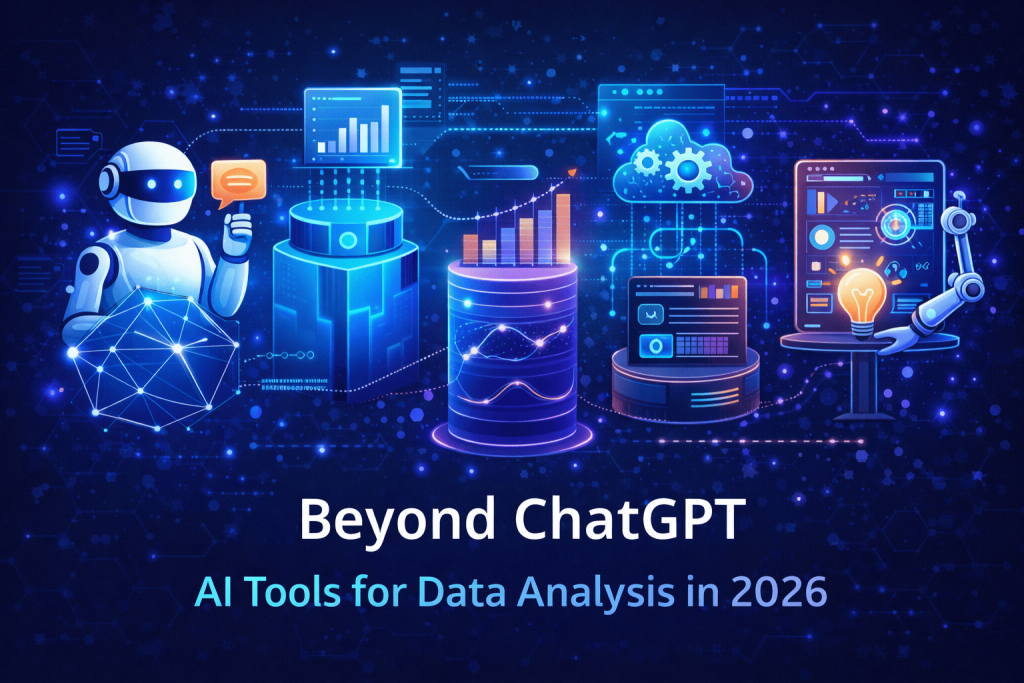

AI tools have become the default entry point into artificial intelligence for many professionals, with ChatGPT often serving as the first exposure to modern AI capabilities. But when it comes to serious data analysis, general-purpose language models quickly reach their limits.
In 2026, the most effective data workflows rely not on one универсальный AI, but on specialized tools designed for specific analytical tasks. These tools go beyond conversation and focus on structure, accuracy, and repeatability.
This article explores why ChatGPT is no longer enough for data analysis and which types of specialized AI tools are shaping modern analytical workflows.
Why ChatGPT Is Not a Data Analysis Tool
ChatGPT excels at reasoning, explanation, and synthesis. However, it was not designed to be a production-grade data analysis system.
Common limitations include:
- Weak handling of large datasets
- Inconsistent results across sessions
- Limited transparency in calculations
- No persistent data models
- Poor integration with real-time data sources
For exploratory thinking, ChatGPT remains valuable. For decision-making based on data, specialized tools perform better because they operate on structured pipelines rather than probabilistic text generation alone.
The Shift Toward Specialized AI Tools
The key trend in 2026 is task-specific intelligence.
Instead of asking one AI to do everything, modern teams assemble stacks where each AI component has a clearly defined role:
- Data ingestion
- Cleaning and normalization
- Statistical analysis
- Visualization
- Forecasting
- Reporting
This modular approach improves reliability and makes automation possible.
Category 1: AI Tools for Automated Data Cleaning
Data cleaning remains one of the most time-consuming steps in analysis.
Specialized AI tools now:
- Detect anomalies and missing values
- Standardize formats automatically
- Suggest transformations based on historical patterns
- Flag inconsistencies before analysis begins
Unlike ChatGPT, these tools operate directly on datasets and maintain reproducibility. They reduce human error and make downstream analysis significantly more reliable.
In practice, this category alone can save more time than any visualization or modeling tool.
Category 2: AI-Powered Exploratory Data Analysis (EDA)
Exploratory analysis is where many analysts still rely on manual queries and charts.
Modern AI EDA tools can:
- Automatically surface correlations and trends
- Generate hypothesis suggestions
- Highlight statistically significant patterns
- Explain findings in plain language
These tools bridge the gap between raw numbers and insight. They do not replace analysts, but they accelerate the path to meaningful questions, which is where real value is created.
Category 3: Predictive and Forecasting AI Tools
Forecasting requires more than pattern recognition. It requires:
- Context awareness
- Model validation
- Scenario testing
Specialized AI forecasting tools combine machine learning with domain-specific assumptions. They allow users to:
- Compare multiple models automatically
- Run sensitivity analyses
- Visualize confidence intervals
- Test “what-if” scenarios
ChatGPT can describe forecasts. These tools produce and validate them.
Category 4: AI Tools for Business Intelligence and Dashboards
Traditional BI tools often require manual setup and constant maintenance.
In 2026, AI-driven BI platforms:
- Build dashboards from natural language queries
- Automatically update metrics as data changes
- Detect anomalies in real time
- Adjust visualizations based on user behavior
The key difference is persistence. These tools remember schema, metrics, and business logic. ChatGPT does not.
For organizations, this turns dashboards from static reports into living systems.
Category 5: AI for Data-to-Decision Workflows
The most advanced tools no longer stop at analysis.
They connect insights directly to actions:
- Trigger alerts when thresholds are crossed
- Generate recommendations based on trends
- Integrate with operational systems
- Log decisions and outcomes for future learning
This is where AI becomes infrastructure rather than assistance. Data analysis is no longer a task, but a continuous process embedded into workflows.
How to Choose the Right AI Tools in 2026
The mistake many teams make is choosing tools based on features instead of workflows.
Better questions to ask:
- Where does data enter the system?
- Who consumes the output?
- How often does the analysis need to run?
- What decisions depend on this data?
- What happens after insight is generated?
Specialized tools win when they reduce friction across the entire lifecycle, not just one step.
The Role of ChatGPT Going Forward
ChatGPT is not disappearing from data workflows.
Its role is shifting toward:
- Framing problems
- Explaining results
- Drafting narratives and reports
- Supporting exploratory thinking
In other words, ChatGPT becomes the interface layer, while specialized AI tools handle execution.
This separation of concerns is what makes modern AI stacks scalable and reliable.
Final Thoughts
The future of data analysis is not about smarter general AI. It is about better systems.
In 2026, the most effective teams combine ChatGPT with specialized AI tools that are purpose-built for data reliability, automation, and decision support.
The real advantage comes not from using AI, but from using the right AI in the right place.
That is where data stops being overwhelming and starts being useful.