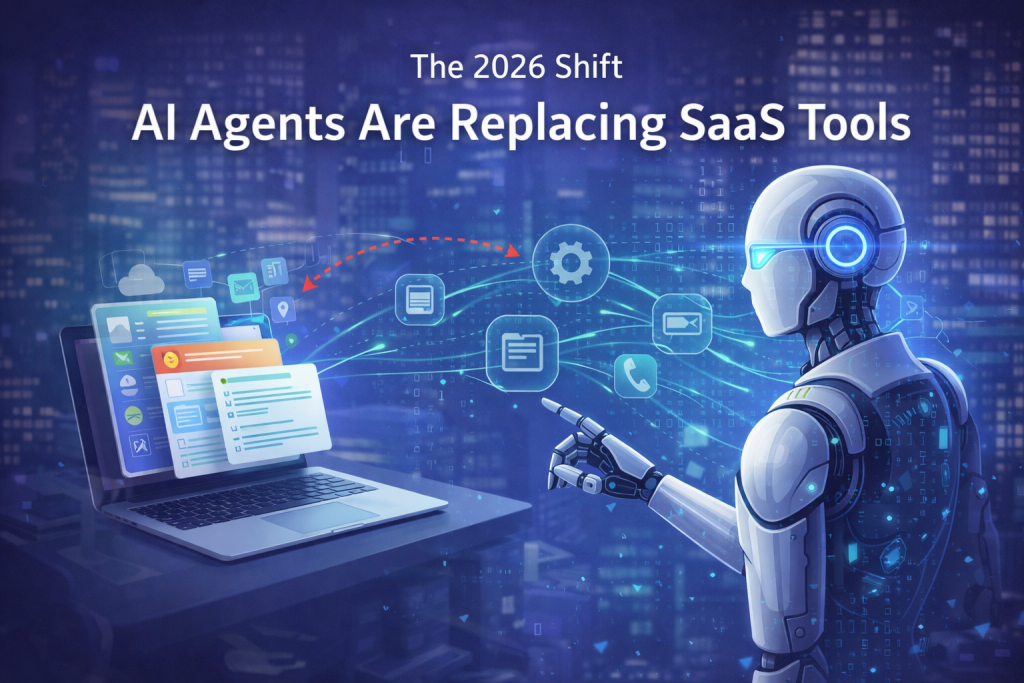

Over the past decade, I’ve watched SaaS products multiply at an incredible pace. Each new problem seemed to require a new dashboard, a new subscription, and a new workflow to manage. By 2026, that model is quietly breaking down. In its place, AI agents are emerging as a fundamentally different way to interact with software and get work done.
This shift is not about faster tools. It’s about fewer tools.
AI agents are changing how businesses think about software itself, moving from isolated applications to intelligent systems that operate across workflows.
From Tool-Centric SaaS to Agent-Centric Workflows
Traditional SaaS tools are built around fixed interfaces. You open an app, perform a task, and move on to the next tool. This model assumes that humans should manage coordination between systems.
AI agents reverse that assumption.
Instead of learning multiple tools, users describe outcomes. The agent decides which systems to use, what data to pull, and which actions to take. This shift mirrors how modern AI tools workflows already reduce friction by connecting systems instead of forcing users to manage individual applications manually. In practice, this means:
- fewer dashboards to manage
- less context switching
- workflows that adapt dynamically instead of following rigid rules
From my experience working with operations and content teams, this shift reduces friction more than any single productivity feature ever could.
Why AI Agents Scale Better Than SaaS Subscriptions
One of the biggest weaknesses of traditional SaaS is fragmentation. As teams grow, they accumulate tools faster than they can integrate them. AI agents thrive in this environment because they sit above the tools, not inside them.
AI agents excel at:
- interpreting intent rather than clicks
- coordinating actions across multiple platforms
- learning patterns from repeated behavior
This makes them especially effective in environments where processes change frequently, such as marketing, analytics, customer support, and internal operations.
“The future of software isn’t more features. It’s fewer interfaces.”
What This Means for Businesses in 2026
By 2026, many teams will no longer ask which SaaS tool to buy. Instead, they will ask how much autonomy they are willing to give an AI agent.
This doesn’t mean SaaS disappears. It becomes infrastructure rather than the primary interface. The visible layer shifts from apps to agents, while traditional tools operate quietly in the background.
The companies gaining the most leverage are those redesigning workflows around agents rather than forcing agents into old SaaS structures.
Common Misconceptions About AI Agents
A mistake I often see is assuming AI agents are just advanced chatbots. In reality, their value comes from orchestration, not conversation.
AI agents fail when:
- processes are undocumented
- permissions are unclear
- human oversight is removed entirely
Successful teams treat agents as operators with boundaries, not replacements for judgment.
One important signal I’m seeing across the industry is how quickly teams become dependent on agent-driven workflows once they adopt them. After the initial setup, most teams don’t want to return to tool-heavy environments.
AI agents quietly absorb coordination tasks that previously required constant human attention: switching between tools, synchronizing data, and translating intent into action. This shift doesn’t eliminate software, but it fundamentally changes how software is experienced.
Instead of managing tools directly, teams manage outcomes. In 2026, that distinction is becoming one of the clearest competitive advantages for modern organizations.
The Long-Term Advantage of Agent-First Thinking
The transition from SaaS-heavy stacks to agent-driven workflows won’t happen overnight. But the direction is already clear. AI agents reduce operational overhead by absorbing complexity instead of exposing it to users.
In 2026 and beyond, competitive advantage will belong to teams that design systems where humans focus on decisions and strategy, while AI agents handle execution and coordination.
That is the real shift. And it’s already underway.